

OTC pharmaceutical distributors in Malaysia are licensed companies that supply non-prescription medicines and health products to pharmacies, supermarkets, health retailers, and other approved channels. These products must carry a valid MAL registration number and be distributed by companies with the appropriate NPRA licence, such as a Wholesaler’s Licence.
Malaysia is a promising market for OTC, consumer health, wellness, and self-care brands, supported by strong pharmacy networks, retail channels, online platforms, and health-conscious consumers.
However, OTC distribution involves more than delivering products to retailers. Brand owners must understand product registration, classification, importation, storage, promotion, and sales requirements. For a broader market-entry overview, read our guide on how to start pharmaceutical distribution in Malaysia
What Makes OTC Distribution Different from Prescription Pharmaceutical Distribution?
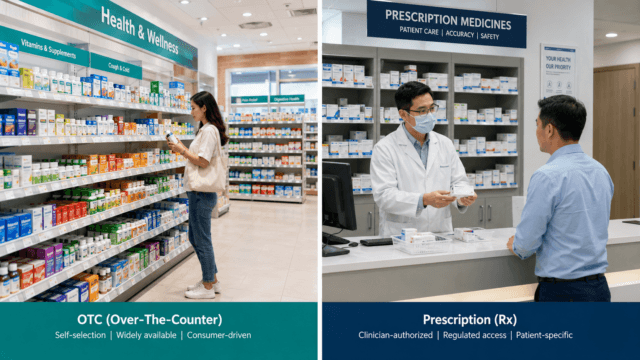
OTC distribution is more retail-driven than prescription pharmaceutical distribution. Prescription medicines usually depend on doctors, hospitals, clinics, tenders, formularies, and medical representatives. OTC products, by contrast, often depend on consumer demand, pharmacy recommendation, shelf visibility, retail promotions, pricing, and repeat purchase behavior.
That means the distributor’s role is different. For OTC products, a good distributor does more than move cartons. They help secure pharmacy listings, manage retail replenishment, support merchandising, coordinate promotions, educate pharmacists or sales staff, and keep the product available where consumers are likely to buy it.
Brand owners should also understand that “OTC” is not always one simple regulatory category. In Malaysia, pharmaceutical products must be registered with the Drug Control Authority before they can be marketed, and a foreign company must appoint a local company as the registration holder or local agent responsible for registration matters.
Malaysia uses product registration codes that help identify the category of a registered product. For example, NPRA’s registration code guidance identifies categories such as A for scheduled poison, X for non-scheduled poison, N for health supplements, and T for traditional products.
For brand owners, this matters because the route to market, claim strategy, advertising approval, pharmacy handling, and distributor requirements may differ depending on whether the product is a non-scheduled OTC medicine, a pharmacist-supplied product, a health supplement, a traditional product, or another regulated category.
Regulatory Requirements for OTC Pharmaceutical Distributors in Malaysia
Any distributor handling OTC pharmaceutical products in Malaysia must meet the same baseline regulatory requirements as prescription distributors. The OTC classification does not reduce the compliance burden, it simply changes the channel.
Wholesaler’s Licence: The Baseline Requirement
Every OTC pharmaceutical distributor must hold a valid Wholesaler’s Licence issued by NPRA. The WDL authorises the holder to purchase, store, and supply pharmaceutical products to licensed pharmacies, hospitals, and clinics.
Verify a distributor’s WDL status before engaging them. The NPRA public register at npra.gov.my allows you to confirm licence status and expiry date. An expired or absent WDL is not a minor compliance gap as it means the distributor cannot legally handle your products, and any products they do handle are in breach of Malaysian pharmaceutical law.
NPRA Product Registration and MAL Numbers for OTC Products
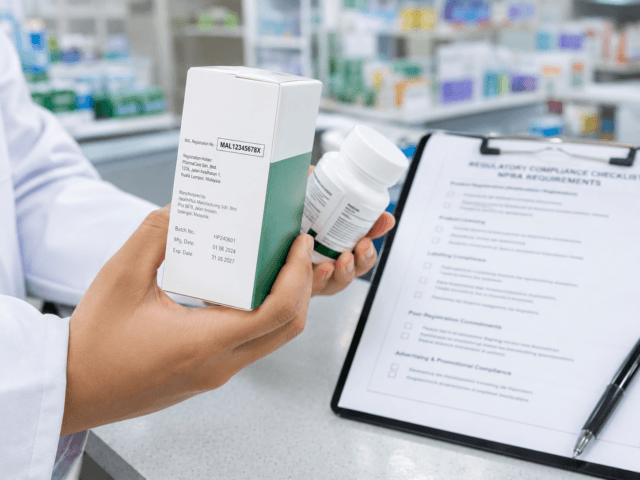
A distributor can only distribute products that carry a valid MAL (Malaysian Approval Letter) number from NPRA. The MAL is proof that your product has passed NPRA’s safety, efficacy, and quality evaluation and is approved for sale in Malaysia.
If your product does not yet have a MAL number, distribution cannot legally begin regardless of how established the distributor is. For foreign brands, securing the MAL is typically the first major timeline challenge in the Malaysian market entry process. Planning for six to twelve months for most pharmaceutical and health supplement registrations is realistic.
A good distribution partner can co-ordinate the MAL application process or refer you to a qualified regulatory consultant. This is worth asking about explicitly during distributor evaluation. For a detailed view of the import and registration process, see our guide to pharmaceutical importers in Malaysia.
Halal Certification for OTC Products: A Growing Channel Requirement
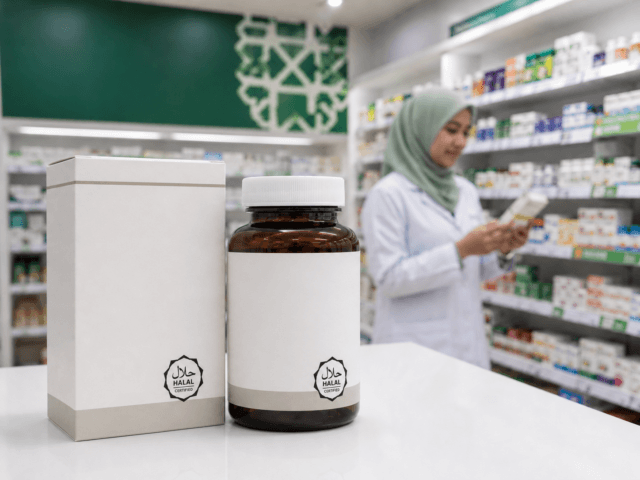
JAKIM halal certification is not a legal prerequisite for distributing OTC health products in Malaysia but it is increasingly a commercial one. Malaysia’s major pharmacy chains and a growing number of independent pharmacies serving Muslim-majority communities will not range products without a valid JAKIM halal certificate for health supplements, vitamins, and wellness products.
For brand owners targeting national OTC coverage, halal certification for applicable product categories should be built into the registration timeline alongside the MAL application. Waiting until after launch to address it means being shut out of a substantial portion of the retail pharmacy channel from day one.
How OTC Distribution Channels Work in Malaysia
Malaysia’s OTC pharmaceutical market reaches consumers through several distinct retail channels, each with different dynamics, buyer relationships, and operational requirements. Understanding how they work helps you set realistic expectations for what a distribution partner can and cannot deliver.
Chain Pharmacy Partnerships: What Distributors Negotiate on Your Behalf
Malaysia’s four major pharmacy chains such as Guardian, Watson, Caring Pharmacy, and Big Pharmacy collectively operate hundreds of outlets nationwide and represent the most visible OTC sales channel for health and wellness products.
Getting a product listed in a chain pharmacy requires a formal buyer presentation, a ranging decision, and a planogram allocation. For new products without an existing Malaysian consumer base, this is not a passive process. A distributor with established chain pharmacy relationships navigates the buyer process on your behalf as they know the buying cycles, the promotional mechanics, and the category ranging criteria for each chain.
What distributors handle on your behalf: shelf space negotiations, promotional trade spend planning, stock rotation agreements, and short-dated or damaged stock returns. These are commercial capabilities built through repeated buyer interactions over years, not something a new market entrant can replicate quickly.
Independent Pharmacies: The Long Tail of OTC Reach in Malaysia
Malaysia has over 3,000 independent community pharmacies operating outside the major chains. They are geographically distributed across urban and semi-urban areas, they serve loyal local customer bases, and for certain product categories like traditional health products, specialised supplements, and community health items.
Reaching independent pharmacies requires a distributor with a dedicated field sales operation and a well-maintained independent pharmacy account list. A distributor focused exclusively on chain pharmacy listings will leave this portion of the market unserved.
For brand owners building genuine national OTC coverage, independent pharmacy reach is the difference between partial distribution and comprehensive market presence. Ask prospective distributors specifically how many active independent pharmacy accounts they service and in which states.
How to Choose an OTC Pharmaceutical Distributor in Malaysia: 6 Things Brand Owners Should Evaluate

If you are looking for a partner that can support licensed warehousing, pharmacy channel coverage, regulatory awareness, and retail execution, Octopus Distribution is a pharmaceutical distributor in Malaysia that helps healthcare and consumer health brands build practical route-to-market strategies.
1. Regulatory Capability
The distributor should understand NPRA registration, import requirements, wholesale licensing, GDP, product classification, and advertising rules. This is especially important for foreign brand owners that need a local agent or Product Registration Holder.
Do not choose a distributor only because they claim to have “many retail contacts.” In pharmaceuticals, regulatory capability is not optional.
2. Channel Coverage
Ask which channels the distributor actually serves. Some are strong in pharmacy chains. Others are better with independent pharmacies, clinics, hospitals, modern trade, or online marketplaces.
The right distributor depends on your product. A premium supplement may need pharmacist recommendation. A fast-moving pain relief brand may need broad pharmacy and modern trade coverage. A niche dermatology OTC product may need targeted pharmacy education rather than mass distribution.
3. Sales and merchandising support
OTC products often fail because they are listed but not actively sold. Brand owners should check whether the distributor can support:
- Pharmacy detailing
- Retail staff education
- Shelf placement
- Point-of-sale materials
- Promotional campaigns
- Sampling programs, where allowed
- Sell-out tracking
- Replenishment follow-up
Getting into stores is only the first step. The real test is whether consumers buy repeatedly.
4. Warehousing and stock management
Pharmaceutical and consumer health products need proper storage, stock rotation, expiry monitoring, and traceability. A distributor should be able to manage FEFO (first-expiry, first-out) and provide visibility on inventory movement.
Poor stock control can damage the brand. Expired or short-dated stock creates retailer frustration, consumer risk, and unnecessary write-offs.
5. Transparency in reporting
Brand owners should ask what reporting they will receive and how often. Useful reports include sales by channel, sales by account, stock on hand, stock aging, promotion results, returns, expiry exposure, and forecast updates.
Without reporting, the brand owner cannot tell whether the distributor is building the market or simply holding inventory.
6. Commercial alignment
The distributor’s margin, payment terms, minimum order quantities, promotional budget, and exclusivity expectations must make sense for both sides.
Be careful with giving exclusive rights too early. Exclusivity should be tied to clear performance targets, such as registration milestones, listing targets, sales volume, channel expansion, marketing activity, and reporting discipline.
Common Mistakes Brand Owners Make When Setting Up OTC Distribution in Malaysia

Brand owners entering the Malaysian OTC market make four mistakes more often than any others. Knowing them in advance costs nothing. Learning them after launch costs considerably more.
Mistake 1: Choosing a Distributor Based on Margin Rather Than Channel Fit
A distributor offering the lowest commission take will often have the weakest pharmacy buyer relationships. In OTC, the distributor’s channel access is the product. A distributor who saves you 2% on margin but cannot secure chain pharmacy ranging has cost you the entire sales opportunity. Evaluate capability first, then negotiate commercials.
Mistake 2: Ignoring Halal Certification Until After Launch
By the time a brand owner realises that their target pharmacy chain requires JAKIM certification, they are already in-market without it. The halal certification application takes time typically several months and the review process cannot be expedited on demand. Start it in parallel with the MAL registration, not after it.
Mistake 3: Underestimating The Working Capital Impact of Pharmacy Payment Cycles
A 90-day pharmacy receivable cycle looks manageable in a financial model. When you have a product sitting across multiple pharmacy chains with no incoming cash for three months while logistics, regulatory, and operational costs continue, the reality is different. This is precisely the scenario where distributor credit facilities shift from a nice-to-have to a business-critical requirement.
Mistake 4: Signing a Distribution Agreement Before MAL Approval Is Confirmed
Some brand owners commit to a distributor before their MAL registration is approved, expecting the approval to arrive shortly. When the MAL is delayed or returned with NPRA queries, the distribution agreement sits idle, the distributor’s attention moves to other brands, and your launch timeline slips. Confirm MAL status, or a realistic and well-supported approval timeline, before signing.
The Malaysian OTC pharmaceutical market rewards brand owners who enter it with the right partner, the right compliance documentation, and realistic expectations about channel timelines. The pharmacy channel here is accessible but it is not passive. Brands that succeed are the ones that choose a distributor with genuine channel relationships and not just a licence and a warehouse, treat the NPRA and JAKIM processes as launch-critical milestones rather than administrative afterthoughts, and ask the hard commercial questions about credit terms, inventory visibility, and channel reach before they sign.
Frequently Asked Questions
Yes, pharmaceutical products generally need to be registered with the Drug Control Authority before they can be marketed in Malaysia. Foreign companies usually need to appoint a local Malaysian company as the registration holder or local agent.
A MAL number is the registration number used for registered pharmaceutical and health-related products in Malaysia. Registered products can be identified by a MAL registration number and a genuine hologram label.
Yes, if the distributor is wholesaling or supplying registered products, they need the appropriate licence. NPRA states that wholesalers require a Wholesaler’s Licence to sell by wholesale or supply registered products from their premises.
Many OTC and consumer health products are promoted to the public, but medicine advertising is regulated. Brand owners should check whether their advertising materials require approval from the Medicine Advertisements Board and ensure claims are consistent with the product’s approved registration and category.
Exclusivity can work, but it should be performance-based. Brand owners should define clear targets for registration, launch timeline, pharmacy listings, sales volume, marketing activity, reporting, and channel expansion before granting exclusivity.
Look for regulatory knowledge, licensed operations, GDP-compliant warehousing, pharmacy and retail coverage, sales team capability, transparent reporting, marketing support, and experience handling products similar to yours.
Looking for a Reliable OTC Pharmaceutical Distributor in Malaysia?
Octopus Distribution helps healthcare and consumer health brand owners navigate OTC distribution with the right mix of regulatory awareness, pharmacy channel access, retail execution, and market growth support.
Whether you are launching a new OTC product or expanding an existing healthcare brand in Malaysia, Octopus Distribution can help you build a practical route-to-market strategy. Get in touch with Octopus Distribution today to discuss your OTC distribution strategy in Malaysia.





