
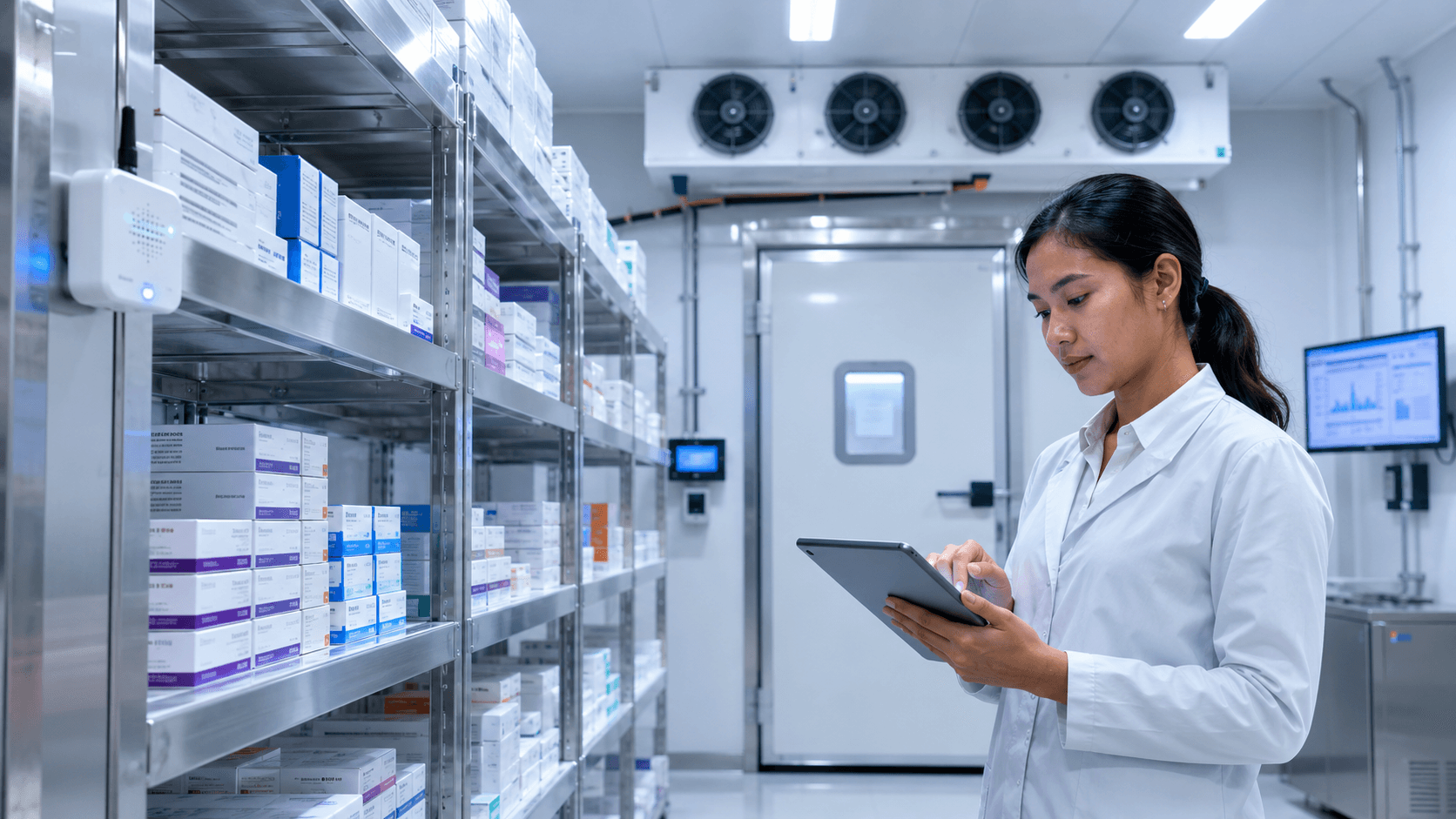
Cold chain technology in Malaysia now goes beyond basic temperature checks. Pharmaceutical and other time-sensitive products increasingly rely on IoT sensors, continuous data logging, real-time monitoring and automated alerts to maintain safe storage and transport conditions.
These systems help operators detect temperature excursions early, maintain clear records and support GDP compliance for Time and Temperature Sensitive Products (TTSP). They also provide the documentation needed for NPRA or Ministry of Health inspections.
Technology does not replace good cold chain procedures, instead it makes them easier to monitor, manage and prove.
Why Cold Chain Technology Has Become a GDP Compliance Baseline
Cold chain monitoring is no longer just an operational upgrade. In Malaysian pharmaceutical distribution, continuous electronic monitoring has become the practical benchmark for GDP-compliant refrigerated storage.
While MOH and NPRA do not specifically mandate IoT sensors, inspectors increasingly expect operators to show that temperature conditions are monitored continuously rather than through manual checks alone. A twice-daily temperature log may miss an overnight refrigeration failure, while electronic monitoring can detect the issue as it happens.
From Manual Logs to Continuous Monitoring
Manual temperature checks leave long gaps between readings, during which an excursion may go unnoticed. With IoT sensors logging temperatures at regular intervals, deviations can be detected quickly, alerts can be sent to the responsible team, and corrective action can begin before the situation worsens.
The main advantage is not only faster response, but also a complete record showing when the excursion started, how long it lasted and what action was taken.
What Regulators Expect From Cold Chain Monitoring
Malaysia’s GDP requirements emphasise continuous monitoring, calibrated sensors, retrievable temperature records and effective alarm systems for temperature-controlled pharmaceutical storage.
In practice, operators should be able to demonstrate:
- Continuous electronic temperature monitoring
- Pre-defined alert thresholds
- Prompt notification of temperature excursions
- Retrievable historical temperature records
- Clear documentation for inspections and investigations
These capabilities are increasingly considered part of a well-controlled GDP-compliant cold chain rather than an optional technology upgrade.
IoT Sensors in Pharmaceutical Cold Chain: How the Technology Works
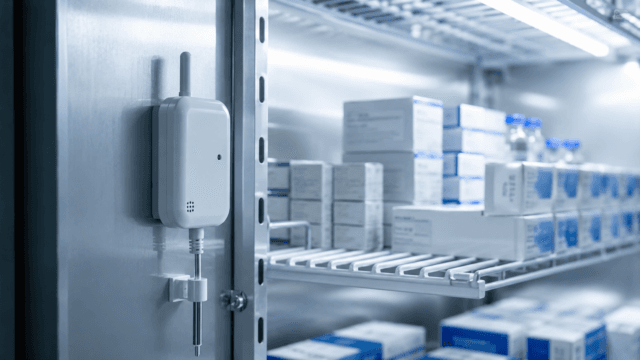
IoT cold chain sensors measure temperature at set intervals and send readings to a central platform. In pharmaceutical warehouses and refrigerated vehicles, the system continuously logs data, checks it against set limits and triggers alerts when temperatures approach or exceed those limits.
The technology itself is well established. What matters is how sensors are positioned, how often data is recorded and how alert thresholds are configured, as these determine whether the system produces meaningful GDP documentation.
Sensor Placement and Density
One sensor cannot represent an entire cold room because temperatures vary between doors, cooling outlets, racks and other areas. Thermal mapping identifies the warmest and coldest points so sensors can be placed where they accurately reflect actual product storage conditions.
Data Logging Intervals
Although GDP guidelines do not prescribe one fixed interval for every situation, 15-minute logging is commonly used in refrigerated pharmaceutical storage. Compared with twice-daily manual checks, frequent electronic readings can detect temperature changes much earlier and provide a clearer record of when an excursion began.
Pre-Limit Alert Thresholds
Alerts should ideally activate before the storage limit is exceeded. For example, in a 2°C–8°C zone, an alert at 7°C gives the team time to investigate and stabilise conditions before an excursion occurs. Waiting until 8°C means the product may already require quarantine and investigation.
Real-Time Monitoring Dashboards: What Pharma Brands Should Be Able to See
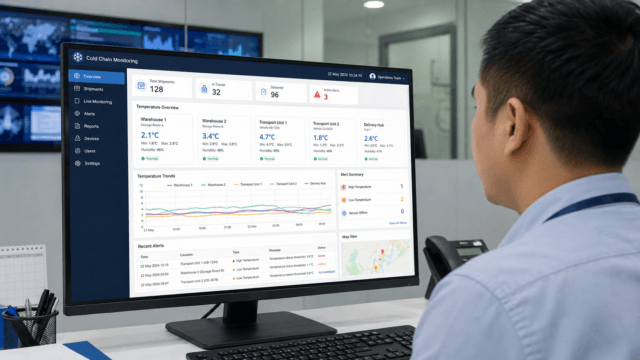
A real-time dashboard gives pharmaceutical brands live visibility of temperature conditions across cold rooms, storage areas and refrigerated vehicles. Instead of waiting for reports, authorised users should be able to see current conditions and identify zones approaching or exceeding their limits.
Remote Access for Brand Owners
Remote access gives pharmaceutical manufacturers greater visibility over products stored by third-party logistics providers. This is especially useful for high-value biologics, specialty medicines and temperature-sensitive products where an excursion could create significant financial and product-quality risks.
Historical Data and GDP Audit Readiness
During a GDP inspection, temperature records may need to be produced for a specific product, location or period. A central digital monitoring system makes historical records easier to retrieve than paper logs or standalone data loggers, reducing the risk of missing or incomplete documentation.
GDP Audit Trails: What the Documentation System Must Produce
A GDP cold chain audit trail should provide a continuous record of product conditions from receipt through storage, transport and final delivery. Together, temperature records, chain-of-custody information and excursion reports should show where the product was, under what conditions and for how long.
From Goods Receipt to Delivery
At receipt, batch details, quantity and initial temperature are recorded. During storage, conditions are monitored continuously. At dispatch, loading details and vehicle temperature are documented, while in-transit sensors continue recording until delivery and final handover.
Reducing Documentation Gaps
Manual systems depend on staff recording every reading correctly and on time, which can create gaps when a check is missed. Automated IoT monitoring records temperatures continuously, sends alerts automatically and stores the data without relying on manual entry.
Excursion Records and CAPA
When an excursion occurs, monitoring data provides the exact start time, maximum temperature, duration and return to compliant conditions. This gives the CAPA investigation reliable evidence and helps teams identify possible causes without reconstructing the event from incomplete records. See our guide to GDP compliance in cold chain logistics.
How to Evaluate a Cold Chain Monitoring System for GDP Compliance
Brand owners and procurement managers should assess whether a logistics partner’s monitoring system can reliably protect products and produce the records needed for GDP compliance.
Calibration and Certificate Management
Cold chain sensors should be calibrated against certified reference standards at defined intervals, with valid certificates showing the calibration date, reference standard and sensor accuracy.
Expired certificates create uncertainty over the reliability of recorded data. Ask your logistics partner how calibration schedules are managed and whether they can provide a current certificate for any sensor on request.
System Validation
Electronic systems used to capture GDP-critical data should be validated to confirm they work as intended.
Validation should cover:
- Sensor accuracy
- Alert functionality
- Data integrity and audit trails
- User and timestamp tracking
- Disaster recovery
This is especially important for operations handling high-value medical devices, biologics or products subject to stricter regulatory expectations such as EU GMP-aligned requirements.
Questions to Ask Your Cold Chain Logistics Provider
Before appointing a partner in Malaysia, ask specific questions about how its monitoring technology operates.
| Question | What You Want to Hear |
| Is temperature monitored continuously? | Monitoring operates around the clock rather than only through manual checks |
| How are sensor locations determined? | Temperature mapping is used |
| Are sensors calibrated? | Calibration follows documented schedules |
| What happens when temperatures approach the limit? | Automated warning and escalation procedures exist |
| Who receives temperature alarms? | Responsibility and escalation are clearly defined |
| What happens during a power failure? | Backup systems and contingency procedures are established |
| Can you show historical temperature data? | Records are retrievable and traceable |
| Can you identify which batches were affected by an excursion? | Temperature and inventory records can be connected |
| How are shipments monitored during delivery? | Validated transport and shipment monitoring are used |
| What documentation is available for audits? | Monitoring, alarm, deviation and corrective-action records can be produced |
Frequently Asked Questions
Cold chain technology refers to the equipment and digital systems used to maintain and monitor temperature-sensitive products during storage and transportation. It can include cold rooms, refrigerated vehicles, data loggers, IoT temperature sensors, monitoring platforms, alarm systems and digital reporting tools.
IoT temperature sensors are connected monitoring devices that measure environmental conditions and transmit the readings to a central system. Unlike a basic thermometer, they can support continuous remote monitoring and automated alerts.
IoT sensors in pharmaceutical cold chain logistics provide continuous temperature readings at 15-minute intervals, transmitted in real time to a central monitoring platform. This replaces manual spot-check logs which create hours-long visibility gaps with an unbroken electronic record. Automated alerts fire when temperatures approach pre-defined thresholds, giving logistics teams time to respond before a GDP excursion is triggered. The data log produced forms the GDP audit trail that MOH and NPRA inspectors review during compliance assessments.
Malaysia’s GDP guidelines, aligned with WHO Good Distribution Practice standards, require continuous electronic temperature monitoring for refrigerated and frozen pharmaceutical storage zones. This means calibrated sensors logging readings at defined intervals of 30 minutes or less, automated out-of-range alerts configured at pre-limit thresholds, retrievable electronic data logs, and current calibration certificates for all monitoring equipment. Manual spot-check logs are insufficient for refrigerated zones under current GDP expectations in Malaysia.
Some can. Octopus Distribution provides medical device registration and regulatory services alongside its warehousing and distribution capabilities, allowing manufacturers to coordinate regulatory and logistics requirements through the same organisation.
Looking for Technology-Enabled Cold Chain Logistics in Malaysia?
For pharmaceutical and healthcare companies, temperature control needs to remain reliable from the moment products enter storage until they reach their next destination.
Octopus Distribution combines GDP-aligned cold-chain infrastructure, real-time IoT temperature monitoring, inventory traceability and documented audit trails to support time- and temperature-sensitive healthcare products across Malaysia.
Whether you need pharmaceutical warehousing, cold-chain transportation or a broader healthcare distribution solution, our team can assess your storage conditions, handling requirements and distribution network.
Talk to Octopus Distribution about your cold-chain logistics requirements in Malaysia.





