

Temperature control is one of the most important parts of pharmaceutical warehousing. Medicines, vaccines, biologics, diagnostic products, and other healthcare goods can lose quality when they are exposed to the wrong storage conditions. In some cases, a short temperature excursion may be enough to trigger a product investigation, quarantine, or disposal.
For pharmaceutical companies in Malaysia, warehouse temperature requirements are not just operational preferences. They are part of Good Distribution Practice, or GDP. A GDP-compliant pharmaceutical warehouse must store each product according to its approved label, manufacturer’s recommendation, and product stability data.
The challenge is that not all pharmaceutical products require the same temperature range. Some products can be kept at controlled ambient temperature, some require cold chain storage, and others need frozen or ultra-low temperature storage.
This guide explains the key differences between ambient, cold chain, and frozen pharmaceutical storage, and what businesses should look for when choosing a temperature-controlled warehouse in Malaysia. For a broader overview of pharmaceutical storage and compliance, read our guide to pharmaceutical warehouse requirements for GDP compliance.
Why Temperature Requirements Matter in Pharmaceutical Warehousing?
Pharmaceutical products are sensitive to their environment. Heat, cold, humidity, light, and poor handling can affect product safety, quality, strength, and stability.
For example, a tablet stored in a hot and humid area may degrade faster than expected. A vaccine exposed to freezing conditions may lose effectiveness. A biologic product kept outside its approved cold chain range may need to be quarantined until the manufacturer confirms whether it is still suitable for use.
That is why temperature-controlled warehousing is a critical part of pharmaceutical logistics. The goal is simple: keep every product within its required storage condition from the moment it arrives until it is dispatched.
A reliable pharmaceutical warehouse should be able to prove temperature compliance with proper monitoring, mapping, records, calibrated devices, alarms, procedures, and trained personnel.
The Main Pharmaceutical Storage Temperature Categories
Pharmaceutical warehouse temperature requirements usually fall into three broad categories: ambient, cold chain, and frozen storage. The exact range must always follow the product label and manufacturer’s storage instructions.
| Storage Type | Typical Requirement | Common Product Examples |
| Controlled Ambient Storage | Often around 18°C to 25°C, depending on product label | OTC medicines, tablets, capsules, medical products, some healthcare goods |
| Cold Chain Storage | Commonly 2°C to 8°C | Vaccines, insulin, biologics, specialty medicines, selected diagnostic products |
| Frozen Storage | Product-specific, commonly below 0°C or around -20°C for some products | Selected biologics, specialty pharmaceuticals, laboratory or clinical materials |
| Ultra-Low Temperature Storage | Product-specific, sometimes -70°C or below | Certain advanced biologics, cell-based products, specialised vaccines or research products |
These ranges are useful for understanding the different categories, but they should never replace the product’s approved storage label. In GDP warehousing, the label always comes first.
1. Ambient Pharmaceutical Storage
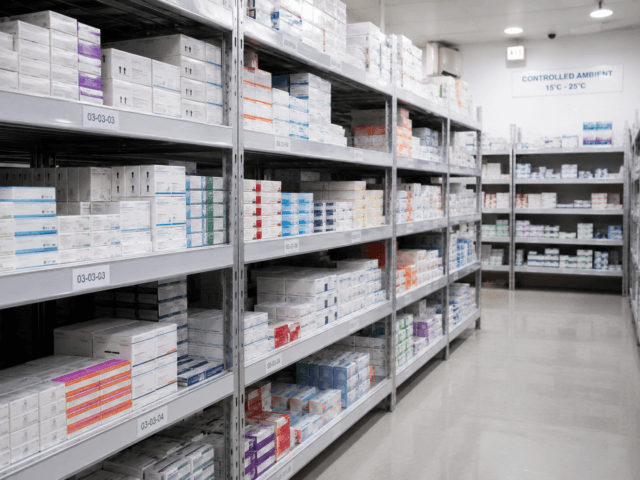
Ambient storage is sometimes misunderstood as ordinary room temperature storage. In pharmaceutical warehousing, ambient storage must still be controlled, monitored, and documented if the product label requires a specific temperature range.
For many pharmaceutical and healthcare products, controlled ambient storage may mean a maintained range such as 18°C to 25°C. This type of storage is commonly used for products that do not require refrigeration but still need protection from excessive heat and humidity.
In Malaysia’s tropical climate, ambient storage should not be treated lightly. External heat, loading bay exposure, poor ventilation, power interruptions, and overcrowded storage areas can all affect warehouse temperature stability.
Products That May Require Ambient Storage
Ambient or controlled room temperature storage may apply to:
- Tablets and capsules
- Some OTC medicines
- Certain prescription medicines
- Medical consumables
- Healthcare products
- Some medical devices with storage limits
- Selected cosmetics or personal care products
Even if a product does not require refrigeration, it still needs suitable storage conditions, clean premises, pest control, security, traceability, and proper stock rotation.
Key Requirements for Ambient Pharmaceutical Storage
A GDP-compliant ambient storage area should include:
- Temperature and humidity monitoring
- Calibrated monitoring devices
- Temperature mapping before use
- Proper ventilation and air-conditioning where required
- Clean and organised storage areas
- Products stored off the floor
- Batch and expiry tracking
- FEFO stock rotation
- Records of temperature readings
- Procedures for temperature excursions
The goal is to prevent heat stress, humidity exposure, contamination, and stock deterioration.
2. Cold Chain Pharmaceutical Storage
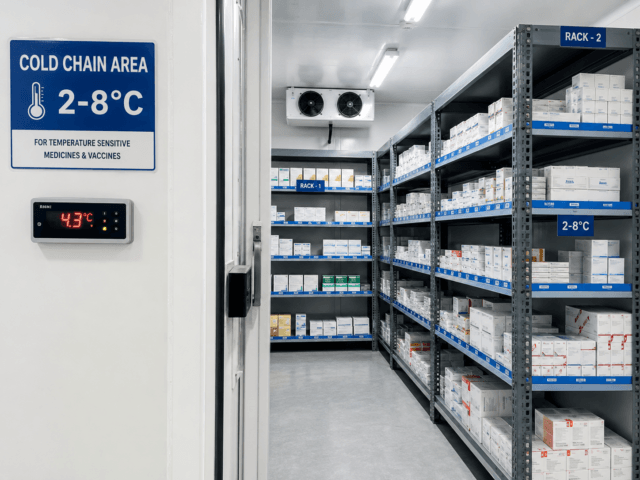
Cold chain storage is required for products that must remain within a refrigerated temperature range, commonly 2°C to 8°C. These products are known as time and temperature sensitive products because their quality depends on staying within the correct temperature range throughout storage and distribution.
Cold chain products require stricter controls than ambient products because they can be affected by both heat and freezing. A product that is supposed to stay between 2°C and 8°C may be damaged if it rises above 8°C or falls below 2°C, depending on the product’s stability profile.
Products That May Require Cold Chain Storage
Cold chain storage is commonly required for:
- Vaccines
- Insulin
- Biologics
- Specialty medicines
- Selected injectable products
- Some diagnostic kits
- Certain clinical trial products
- Temperature-sensitive medical products
Because these products can be high-value and sensitive, cold chain storage must be supported by strong procedures, reliable equipment and require reliable cold chain logistics in Malaysia from storage to final delivery. .
Key Requirements for Cold Chain Storage
A GDP-compliant cold chain warehouse should include:
- Qualified cold rooms, refrigerators, or cold storage areas
- Continuous temperature monitoring
- Alarm systems for temperature excursions
- Calibrated temperature sensors
- Temperature mapping studies
- Backup power or contingency storage
- Documented maintenance programmes
- Trained personnel
- Cold chain receiving checks
- Temperature excursion procedures
- Batch-level traceability
- Validated or qualified packaging for delivery
Cold chain compliance does not end inside the warehouse. The product must also remain within the required range during receiving, picking, packing, loading, transport, and delivery.
3. Frozen Pharmaceutical Storage
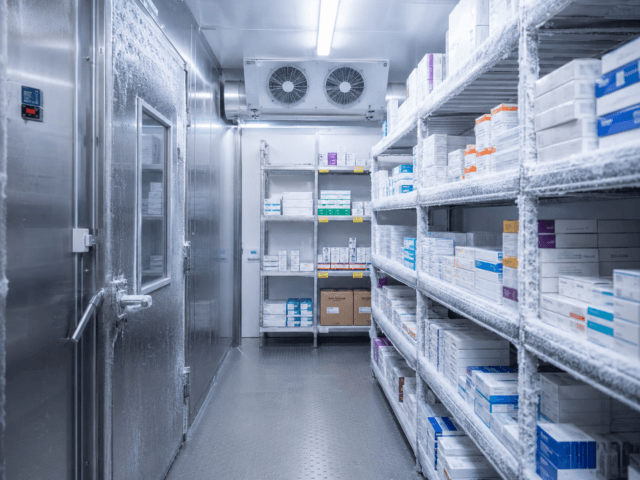
Frozen pharmaceutical storage is required when products must be kept below freezing point. The exact range depends on the product. Some frozen products may require storage around -20°C, while others may need deeper frozen or ultra-low temperature conditions.
Frozen storage is usually more specialised than ambient or 2°C to 8°C cold chain storage. It requires suitable freezer rooms, pharmaceutical-grade freezers, validated packaging, strict handling time controls, and clear emergency procedures.
Products That May Require Frozen Storage
Frozen storage may apply to:
- Selected biologics
- Certain specialty pharmaceuticals
- Some clinical trial materials
- Laboratory reagents
- Certain vaccines or advanced therapy products
- Temperature-sensitive research products
Not every pharmaceutical warehouse needs frozen storage, but companies handling frozen products must confirm that the warehouse has the correct equipment, monitoring system, backup plan, and trained personnel.
Key Requirements for Frozen Storage
A GDP-compliant frozen storage setup should include:
- Freezers or freezer rooms suitable for pharmaceutical products
- Product-specific temperature range control
- Continuous temperature monitoring
- Calibrated sensors and alarms
- Backup power or emergency transfer arrangements
- Temperature mapping
- Controlled access
- Safe handling procedures
- Procedures for dry ice where applicable
- Clear records of storage and movement
- Temperature excursion investigation process
Frozen products can be highly sensitive during transfer. Even a short handling delay at room temperature may create risk. This makes receiving, packing, and dispatch discipline especially important.
What Happens During a Temperature Excursion?
A temperature excursion happens when a product is exposed to temperatures outside its approved storage range. This can occur during receiving, warehouse storage, picking, packing, loading, transport, or delivery.
Common causes include:
- Power failure
- Cold room breakdown
- Door left open too long
- Poor loading bay control
- Incorrect packaging
- Delayed dispatch
- Transport vehicle failure
- Data logger failure
- Incorrect temperature setting
- Overloaded storage equipment
When an excursion happens, the affected product should not be released automatically. It should be identified, quarantined, investigated, and assessed based on documented procedures. The manufacturer or product owner may need to confirm whether the product remains suitable for use.
Temperature Excursion Checklist
A warehouse should be able to:
- Identify the affected product, batch, and quantity
- Confirm the duration of the excursion
- Review temperature records
- Quarantine affected stock
- Notify responsible personnel
- Contact the manufacturer or client where required
- Document the investigation
- Record the final product decision
- Implement corrective and preventive action
A good warehouse does not just detect temperature excursions. It responds quickly, documents clearly, and prevents recurrence.
How to Choose a Temperature-Controlled Pharmaceutical Warehouse in Malaysia
When choosing a pharmaceutical warehouse provider, ask whether they can support the full temperature profile of your products.
A reliable provider should be able to demonstrate:
- GDP-compliant storage procedures
- Controlled ambient and/or cold chain capability
- Product-specific temperature handling
- Continuous temperature monitoring
- Calibrated sensors and equipment
- Temperature mapping records
- Alarm and escalation procedures
- Backup power or contingency arrangements
- Batch and expiry tracking
- FEFO stock rotation
- Secure storage for controlled or poison-class products
- Trained warehouse personnel
- Clear temperature excursion procedures
- Full documentation for audit support
- Warehouse management system visibility
The right partner should not only store your products. They should protect product quality, maintain traceability, and support compliance throughout the supply chain.
Frequently Asked Questions
Under Malaysia’s GDP guidelines, the standard temperature zones are: ambient (15°C to 25°C, or up to 30°C for some products as defined in their storage specifications), refrigerated (2°C to 8°C for cold chain products including vaccines and biologics), and frozen (below −20°C for applicable biologics and plasma products). The specific requirement for any product is defined in its approved product information and takes precedence over general zone definitions.
Yes. GDP guidelines require continuous electronic temperature monitoring for refrigerated and frozen zones, calibrated sensors, retrievable data logs at defined intervals, and automated out-of-range alerts. Manual spot-check records are not sufficient for these zones. For ambient zones, continuous monitoring is best practice and increasingly the expectation during GDP inspections, even where not explicitly mandated.
Immediately quarantine the affected product batches and restrict their movement. Record the start time, duration, and maximum temperature of the excursion. Investigate the cause. Obtain a disposition decision from the responsible pharmacist or quality manager based on the product’s stability data. Document every step. If the excursion results in a quality failure affecting stock already distributed, assess whether notification to NPRA or MOH is required.
Calibration frequency is defined in the facility’s SOP, guided by the sensor manufacturer’s recommendations and GDP expectations. Annual calibration is most common, but some facilities calibrate high-criticality zones twice yearly. What matters for GDP compliance is that calibration is performed at the defined interval, that certificates are current, and that all sensors are within their calibration validity period at the time of any inspection.
Does your pharmaceutical warehousing meet GDP temperature requirements?
Octopus Distribution operates GDP-certified cold chain and ambient pharmaceutical storage in Malaysia, with real-time IoT temperature monitoring, calibrated sensor networks, and documented excursion response procedures.
If your business needs GDP-compliant pharmaceutical warehousing in Malaysia, Octopus Distribution can support controlled ambient and cold chain storage requirements. Contact us to discuss your storage requirements.





