
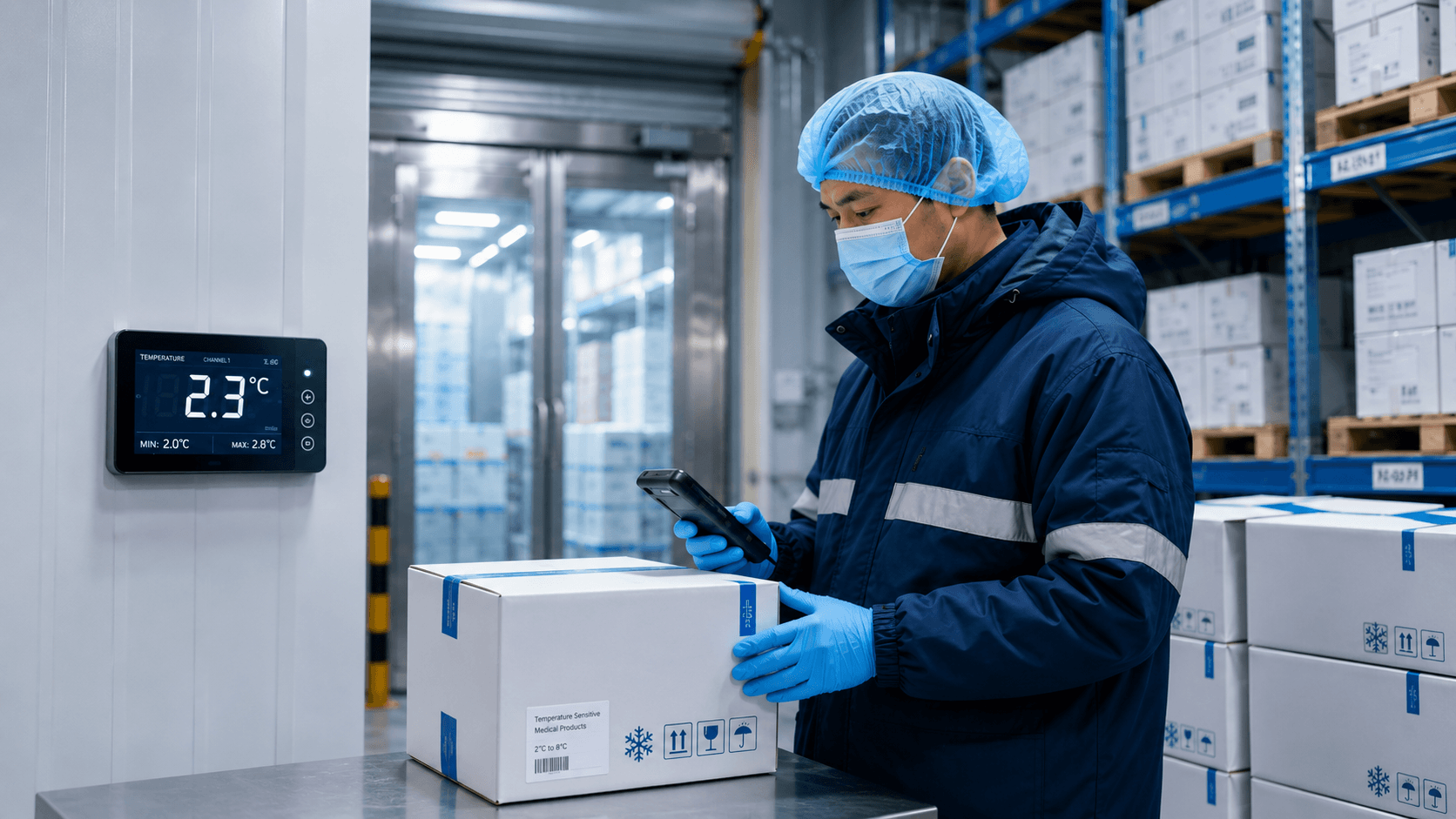
Cold chain logistics plays a critical role in Malaysia’s pharmaceutical and healthcare supply chain. Vaccines, insulin, biologics, diagnostic kits and other temperature-sensitive healthcare products must remain within specified conditions throughout storage, handling and transportation.
A product may leave the manufacturer in perfect condition, but exposure to unsuitable temperatures during warehousing or delivery can affect its quality, stability or performance. Because temperature-related degradation may not be visible, complete monitoring records are essential for confirming that the product remained within its approved range.
Cold chain logistics therefore involves more than refrigerated storage or transport. It requires qualified facilities, validated packaging, continuous temperature monitoring, trained personnel, documented procedures and a clear response plan when deviations occur.
What Is Cold Chain Logistics and Why Does It Matter for Pharmaceuticals?
The cold chain is a connected series of controlled environments covering warehouses, vehicles, handling areas and delivery points. Each stage must maintain the required temperature range, with documentation proving that conditions were preserved throughout the journey.
When the chain works properly, a vaccine delivered to a clinic in Kota Kinabalu should remain within the same approved conditions maintained when it left the manufacturer. When the chain breaks because a vehicle was not pre-cooled, a data logger was not activated or a shipment remained on a loading dock in Malaysia’s heat and the product may be compromised.
In Malaysia, pharmaceutical cold chain operations are governed by Good Distribution Practice, or GDP, requirements. These requirements apply to licensed distributors handling temperature-sensitive pharmaceutical products.
Pharmaceutical Cold Chain vs Food Cold Chain
Food and pharmaceutical cold chains may appear similar, but the compliance requirements are different.
A short temperature variation in food logistics may primarily affect product quality. For pharmaceutical products stored between 2°C and 8°C, a temperature breach can trigger a formal process involving quarantine, investigation and a documented disposition decision before the stock can be released.
Pharmaceutical cold chains also require calibrated monitoring equipment, retrievable temperature records, documented handovers and written procedures for storage, transport and excursion management.
Which Products Require Cold Chain Logistics in Malaysia?
Products commonly requiring temperature-controlled handling include: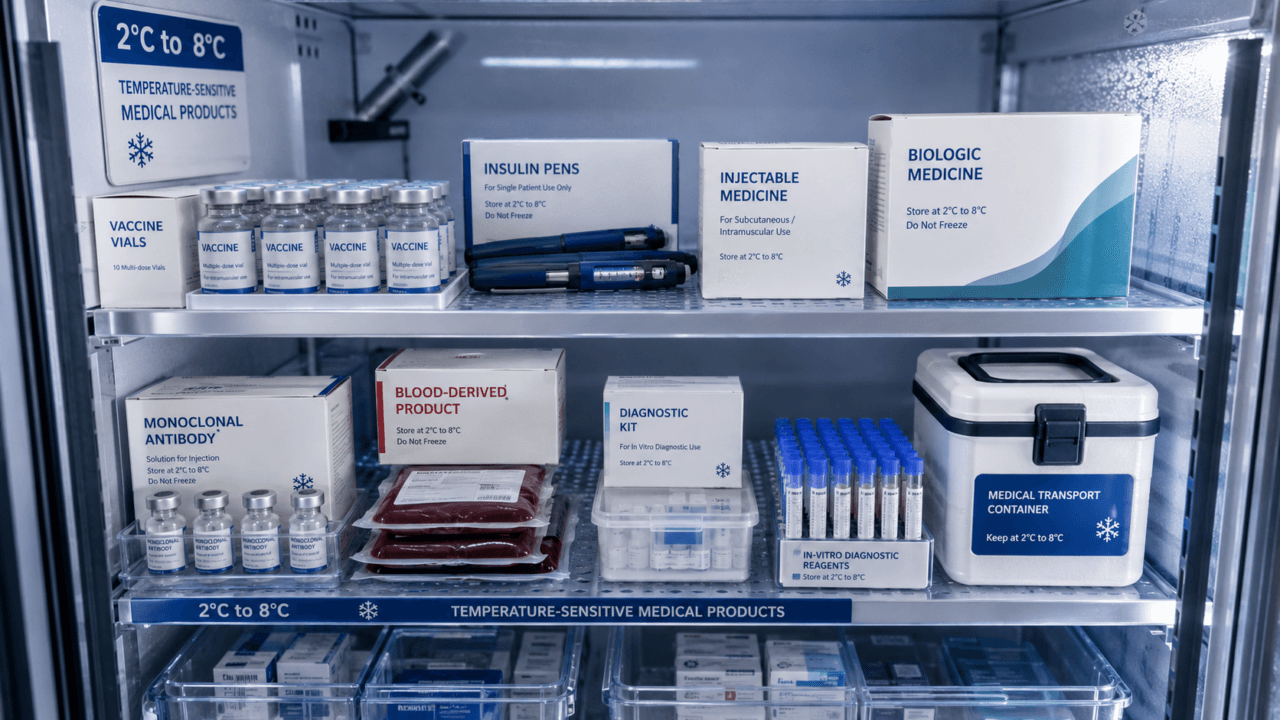
- Vaccines
- Insulin and injectable diabetes medications
- Biological medicines and biosimilars
- Monoclonal antibodies
- Blood-derived products
- Clinical-trial materials
- Diagnostic kits and in-vitro diagnostic reagents
- Selected medical devices containing biological or temperature-sensitive components
- Certain frozen or ultra-cold biological products
The required storage condition must always follow the product’s approved label and manufacturer specifications rather than its general product category.
Regulatory Framework Governing Cold Chain Logistics in Malaysia
Pharmaceutical products and medical devices are governed by separate regulatory frameworks. Companies distributing both categories must ensure that their logistics arrangements meet the relevant requirements for each product.
MOH and NPRA Good Distribution Practice Requirements
Good Distribution Practice is the primary framework for pharmaceutical storage and distribution in Malaysia. It covers the systems needed to preserve product quality throughout the supply chain.
Cold chain requirements commonly include:
- Continuous temperature monitoring using calibrated equipment
- Documented chain of custody at each handover
- Retention of temperature records
- Written procedures for loading, transit, delivery and deviations
- Qualification of storage facilities and vehicles
- Calibration and maintenance records
- Quarantine procedures for affected products
- Staff training and defined responsibilities
Compliance may be assessed through inspections by the relevant authorities. Inspectors can review temperature logs, calibration certificates, standard operating procedures, training records and temperature-excursion investigations.
Wholesaler’s Licence and Cold Chain Distribution
A Wholesaler’s Licence is a key operating requirement for pharmaceutical distributors in Malaysia. A distributor handling temperature-sensitive products should be able to demonstrate that its licence, facilities, monitoring systems, vehicles and procedures are appropriate for those products.
Brand owners should verify that a prospective logistics provider has current authorisation and can support the required product categories, rather than confirming only that the company operates a warehouse. For a complete explanation of what GDP compliance specifically requires for cold chain operations, see our guide to GDP compliance in cold chain logistics.
MDA and GDPMD Requirements for Cold Chain Medical Devices
Medical devices requiring cold chain handling are subject to the GDPMD framework, administered by MDA. GDPMD requirements mirror pharmaceutical GDP in structure controlled storage, temperature monitoring, batch traceability, SOPs but apply specifically to the Class A through D device classification system. Medical device companies distributing cold chain products in Malaysia need a partner holding GDPMD certification from MDA alongside their pharmaceutical WDL. These are separate regulatory frameworks with separate inspection regimes.
Temperature Zones in Pharmaceutical Cold Chain Logistics
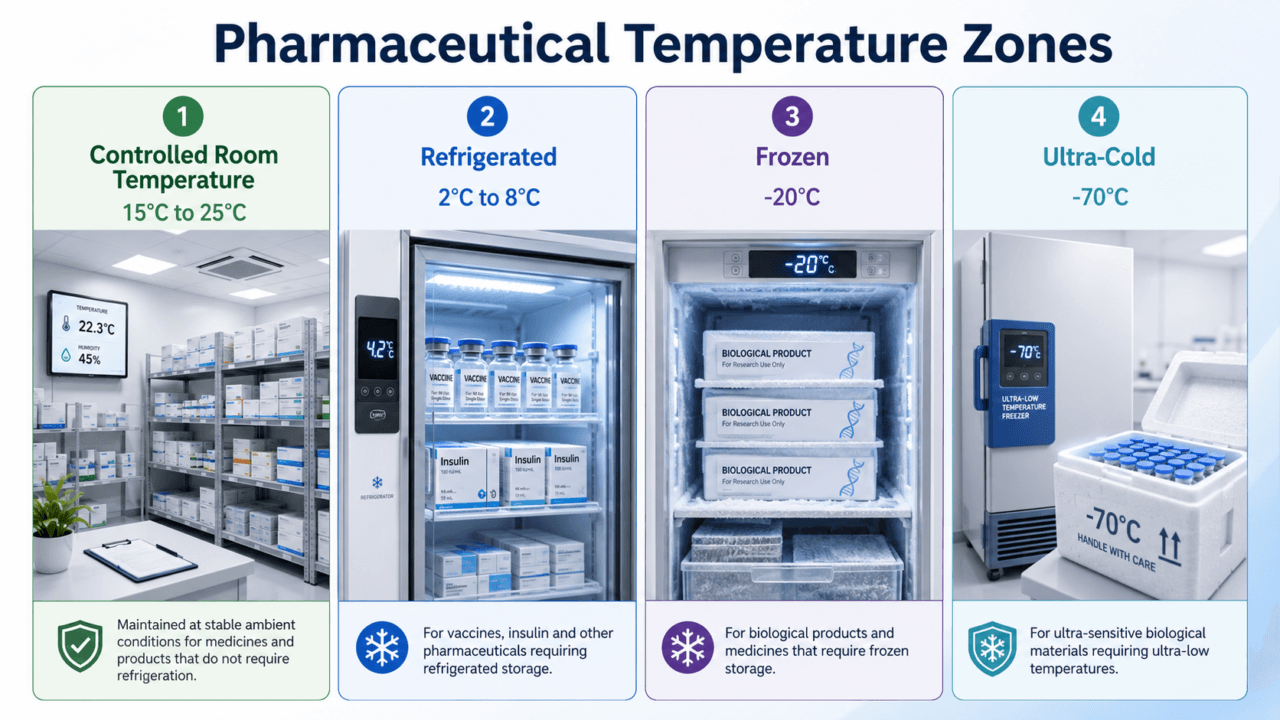
The correct temperature zone is defined by the product’s approved storage information. If the label states “Store at 2°C to 8°C,” that range governs warehousing, transport, handling and delivery.
Controlled Room Temperature
Pharmaceutical products stored at controlled room temperature still require active environmental control in Malaysia’s climate. A warehouse cannot assume that “ambient” means no monitoring is needed.
Controlled room-temperature areas generally require:
- Air-conditioning or HVAC systems
- Continuous environmental monitoring
- Defined alert limits
- Backup procedures for system failure
- Quarantine procedures when limits are exceeded
The exact range may vary according to the product specification. Common controlled ranges include 15°C to 25°C or 18°C to 25°C.
Refrigerated Storage: 2°C to 8°C
The 2°C to 8°C range is the main pharmaceutical cold chain zone for vaccines, insulin, biologics, selected injectable medicines and many diagnostic products.
Products may be damaged by excessive heat, but some can also be affected by freezing. Gel packs or ice packs must therefore be conditioned and positioned correctly so that they do not come into direct contact with freeze-sensitive products.
Continuous monitoring and pre-limit alerts are important. An alert triggered before the temperature reaches the approved limit gives the warehouse team time to investigate and take corrective action.
Frozen and Ultra-Cold Storage
Certain biological products, plasma-derived products and specialised therapies require frozen or ultra-low-temperature storage.
These products may require:
- Dedicated freezer equipment
- Dry-ice or specialised packaging systems
- Continuous electronic monitoring
- More frequent alarm checks
- Strict access controls
- Detailed emergency-transfer procedures
- Shorter and carefully planned delivery windows
Although the operating temperatures differ, the underlying GDP principles remain the same: qualification, monitoring, documentation, traceability and documented deviation management.
Controlled Room Temperature vs Cold Chain
A product labelled “Store below 30°C” does not have the same infrastructure requirements as one labelled “Store at 2°C to 8°C.” Misinterpreting this distinction can lead to unnecessary costs or, more seriously, unsuitable handling.
When storage classification is unclear, companies should refer to the approved Malaysian product information and manufacturer instructions before designing the distribution process.
Cold Chain Logistics Infrastructure in Malaysia
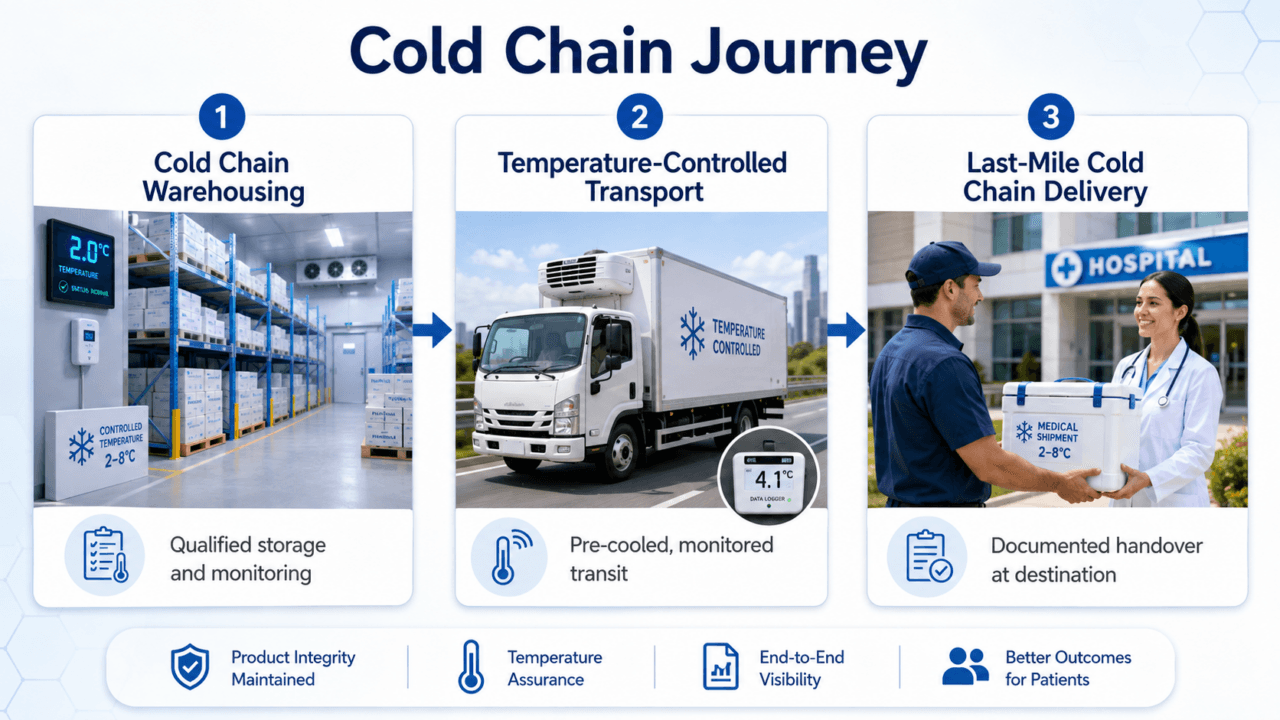
A pharmaceutical cold chain normally includes three connected stages: temperature-controlled warehousing, qualified transport and last-mile delivery. A failure at any stage can compromise the overall system.
Cold Chain Warehousing
The warehouse is the anchor point of the cold chain. A compliant facility should include:
- Qualified temperature-controlled storage zones
- Calibrated electronic monitoring systems
- Automated alerts for out-of-range conditions
- Quarantine areas for affected or pending-release stock
- Backup power or emergency transfer arrangements
- Retrievable temperature and inventory records
- Defined cleaning, maintenance and pest-control programmes
Temperature mapping is used to identify hot and cold spots within a room, refrigerator, freezer or storage area. The results determine where products may be stored and where monitoring sensors should be positioned.
The warehouse should also provide suitable segregation for saleable, returned, recalled, rejected, expired and quarantined stock. For a detailed breakdown of what GDP-compliant pharmaceutical storage requires, see our guide to pharmaceutical warehouse temperature requirements.
Temperature-Controlled Transport
A refrigerated truck alone does not prove that a vehicle is suitable for pharmaceutical products. Cold chain vehicles should be qualified through thermal mapping under representative operating conditions.
Vehicle qualification helps determine:
- Temperature distribution inside the load compartment
- Suitable sensor locations
- Correct loading patterns
- Maximum product load
- Temperature recovery after door openings
- Acceptable transit duration
- Performance under Malaysian weather conditions
Vehicles should be pre-cooled before products are loaded. Loading times, temperature confirmation, batch information and shipment details should be documented.
For smaller deliveries, qualified insulated boxes with conditioned gel packs, phase-change materials or dry ice may be used. The packing configuration should be designed for the product range, expected journey duration and external conditions.
Last-Mile Cold Chain Delivery
Last-mile delivery can be one of the most vulnerable stages. Traffic congestion, multiple delivery stops, hospital loading-bay delays and repeated vehicle-door openings may extend transit times beyond the original plan.
A suitable last-mile procedure should define:
- Maximum delivery duration
- Acceptable loading and unloading time
- Actions when a recipient is unavailable
- Temperature-monitoring requirements
- Handling during multiple-drop routes
- Procedures for delayed or rejected deliveries
- Return-to-warehouse arrangements
Deliveries to Sabah and Sarawak may involve additional road, air or sea handovers. Packaging duration, carrier coordination and contingency planning are especially important for these routes.
Monitoring Technology and Cold Chain Documentation
Real-Time Temperature Monitoring and Alerts
Modern pharmaceutical cold chains increasingly use connected monitoring systems that provide remote access to temperature readings.
An effective system may include:
- Calibrated sensors across storage and transport zones
- Automatic readings at defined intervals
- Pre-limit and out-of-range alerts
- Remote dashboards
- Escalation notifications
- Downloadable temperature reports
- Records linked to specific shipments or storage areas
Real-time alerts help teams respond while a problem may still be correctable. A deviation discovered several hours later provides fewer options and may result in affected stock being quarantined.
Chain of Custody and Audit Trails
Every handover should be documented. When products leave a warehouse, the shipment record should identify what was dispatched, the relevant batches and the temperature conditions maintained during transit.
A complete audit trail may include:
- Goods-receipt records
- Batch and expiry information
- Warehouse movement records
- Packing and dispatch records
- Temperature reports
- Vehicle and driver details
- Delivery confirmation
- Deviation and investigation reports
- Final product disposition
These records support regulatory inspections, customer audits, complaints, recalls and investigations.
Managing Temperature Excursions
A temperature excursion occurs when a product is exposed to conditions outside its approved range. The product should not automatically be released or destroyed without an assessment.
A typical excursion-management process includes:
- Quarantining the affected stock
- Securing temperature and shipment records
- Determining the duration and extent of the exposure
- Reviewing the product’s stability information
- Consulting the manufacturer or product owner
- Recording the release, rejection or disposal decision
- Investigating the root cause
- Implementing corrective and preventive action
The decision must be based on product-specific evidence. Packaging that appears undamaged does not confirm that the contents remain suitable for use.
How to Choose a Pharmaceutical Cold Chain Logistics Company in Malaysia
A healthcare company should assess a provider’s compliance systems and operational evidence, not only the availability of refrigerated storage.
1. Current Licensing and Compliance Status
Verify that the provider holds the relevant licences and certifications for the products being handled. Ask about its latest inspection, audit history and corrective-action process.
2. Monitoring Technology
Request details about sensor calibration, alert limits, response times and access to shipment data. The provider should be able to explain who receives an alert and what happens after it is triggered.
3. National Distribution Capability
Confirm whether the provider can support the required delivery locations, including Sabah and Sarawak where applicable. Ask for details about facilities, qualified vehicles, packaging systems and local delivery arrangements.
4. Excursion-Management Procedures
A reliable provider should have a written procedure covering quarantine, investigation, manufacturer consultation, product disposition and corrective action.
5. Integrated Warehousing and Distribution
Using one provider for warehousing, transport and last-mile delivery can reduce compliance gaps between separate operators. Integrated operations may also improve shipment visibility, inventory control and accountability.
Frequently Asked Questions
Vaccines, insulin, biologics, selected injectable medicines, clinical-trial materials, diagnostic reagents and certain medical devices may require cold chain logistics. The approved label and manufacturer’s instructions determine the exact conditions.
The most common refrigerated range is 2°C to 8°C. Some products require controlled room temperature, frozen conditions or ultra-cold storage. The product’s approved specification always takes priority.
Products move through qualified storage, packing, transport and delivery processes while temperature conditions and chain of custody are continuously documented. Each handover must preserve both the physical conditions and the records needed to demonstrate compliance.
Pharmaceutical distribution is governed through Malaysian GDP and licensing requirements, while medical-device distribution is covered by GDPMD under the Medical Device Authority.
Protecting Healthcare Products from Warehouse to Patient
Cold chain logistics in Malaysia is a regulated and documentation-driven operation, not simply an upgraded version of standard delivery. Reliable systems protect the quality of medicines, the performance of medical devices and the patients who depend on them.
For pharmaceutical manufacturers, medical-device companies, healthcare brands and clinical-research organisations, the right logistics partner must be able to maintain specified temperatures, monitor each stage, respond to deviations and provide clear records.
Octopus Distribution provides integrated cold chain logistics in Malaysia for pharmaceutical and medical-device products, combining temperature-controlled warehousing, qualified packaging, inventory traceability and nationwide healthcare distribution.
Contact Octopus Distribution to discuss a cold chain solution tailored to your product specifications, storage requirements and distribution network.





