

Halal certification has become an important commercial consideration for pharmaceutical and health product brands in Malaysia, particularly for OTC products, supplements and consumer health items sold through pharmacies. This guide explains what halal pharmaceutical distribution means, why certification matters, how JAKIM certification works, the main compliance requirements and the market opportunity for brands that get it right.
What Is Halal Pharmaceutical Distribution in Malaysia?
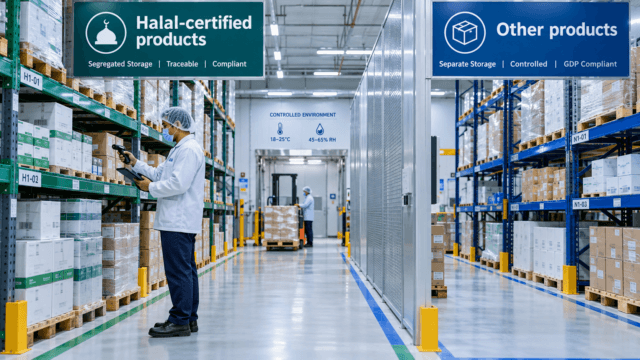
Halal pharmaceutical distribution refers to the end-to-end handling of pharmaceutical and health products in a manner that maintains their halal status from the point of manufacture through to the point of sale. It is not limited to the product’s ingredient list. A product formulated with entirely halal-compliant ingredients can still lose its halal status if it is stored, transported, or handled alongside non-halal products without proper segregation, a concept known as cross-contamination risk in halal supply chain management.
For a distributor, this means halal pharmaceutical distribution is an operational discipline as much as a product attribute. It requires segregated storage where necessary, documented handling procedures that prevent cross-contact with non-halal items, and supply chain traceability that can demonstrate halal integrity was maintained at every stage, not just claimed at the point of manufacture.
This applies most directly to OTC products, health supplements, vitamins, and certain topical preparations, the categories where halal status is both religiously relevant and commercially visible to the end consumer. Prescription pharmaceuticals are less commonly marketed on halal status, though the underlying certification principles can still apply where relevant.
Halal certification vs pharmaceutical registration — two separate approvals
Halal certification and NPRA product registration are entirely separate regulatory processes governed by different authorities, and a product needs to be both legally sellable and halal-marketable in Malaysia. NPRA registration covered in our guide to pharmaceutical distributors in Malaysia confirms the product is safe, effective, and quality-assured. JAKIM halal certification confirms the product meets Islamic dietary and purity standards. Neither approval substitutes for the other, and a product can be fully NPRA-registered while holding no halal status at all.
Why Halal Certification Matters for Pharmaceutical Distribution
For brand owners weighing whether halal certification is worth the investment, the commercial case in Malaysia is direct rather than aspirational. Malaysia’s population is majority Muslim, and halal status has become an active purchase filter for a significant proportion of consumers buying OTC health products, supplements, and personal care items, not a passive preference but a deliberate screening criterion applied at the shelf.
Retail channel access is where this becomes a hard commercial constraint rather than a soft consumer preference. Malaysia’s major pharmacy chains increasingly will not range certain health supplement and OTC categories without a valid JAKIM certificate, particularly where competing halal-certified products already occupy the category. A brand without certification is not simply less attractive on the shelf in some categories, it may not get shelf space at all.
There is also a regional dimension. Malaysia’s JAKIM certification is one of the most internationally recognised halal certification standards in the world, accepted across much of the Muslim-majority ASEAN market and beyond. For brands with regional ambitions, securing JAKIM certification in Malaysia can function as a credential that supports market entry into Indonesia, Brunei, and parts of the Middle East, where halal compliance expectations are similarly stringent.
The reputational cost of getting halal claims wrong
Malaysian consumers and regulators alike treat false or unsubstantiated halal claims seriously. A product marketed with halal messaging but lacking a valid JAKIM certificate, or a distributor found to have compromised halal integrity through improper storage or handling, faces reputational damage that is difficult to reverse in a market where halal trust is foundational to purchase decisions. This is a further reason certification and proper handling should be treated as a compliance discipline, not a marketing afterthought applied loosely to packaging.
Who Regulates Halal Pharmaceuticals in Malaysia?
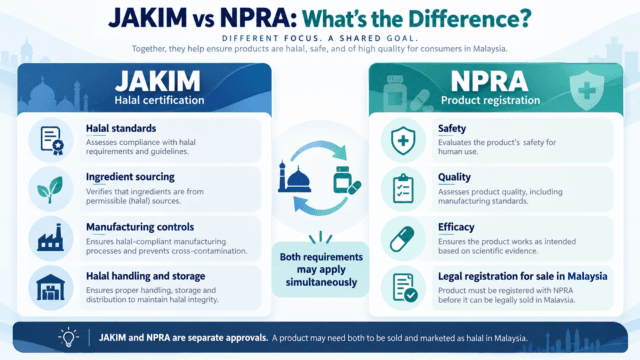
Halal certification in Malaysia sits under a distinct regulatory structure from pharmaceutical safety regulation, and understanding both is necessary to operate compliantly in this space.
JAKIM — the Department of Islamic Development Malaysia
JAKIM (Jabatan Kemajuan Islam Malaysia) is the federal authority responsible for halal certification in Malaysia. JAKIM sets the halal standards, audits and certifies manufacturing facilities and products, and maintains the official halal logo that certified products are entitled to display. JAKIM’s certification framework is built around the Malaysian Standard MS 1500, which sets out halal production, preparation, handling, and storage requirements across food, cosmetics, and pharmaceutical categories.
For pharmaceutical and health products specifically, JAKIM certification assesses ingredient sourcing, manufacturing process controls, and critically for distributors, the supply chain handling that occurs after manufacture, including storage and transport arrangements that could compromise halal status through cross-contact with non-halal materials.
NPRA and the overlap between safety regulation and halal certification
NPRA and JAKIM operate independently, but for a distributor handling halal-certified pharmaceutical and health products, both sets of requirements apply simultaneously. A product must be NPRA-registered to be legally sold in Malaysia at all, and separately JAKIM-certified to carry halal marketing claims. A distributor’s GDP-compliant storage and handling obligations under NPRA’s framework must be layered with halal segregation requirements where applicable meaning a distributor handling both halal and non-halal product lines needs storage protocols that satisfy both regulatory frameworks concurrently.
What Are the Halal Requirements for Pharmaceutical Products?
Halal requirements for pharmaceutical and health products under JAKIM’s framework span three areas: ingredient sourcing, manufacturing process, and supply chain handling. A distributor’s responsibility sits primarily in the third area, but understanding all three is necessary to work credibly with brand owners on halal-certified product lines.
Ingredient sourcing and formulation requirements
Halal-compliant pharmaceutical products must avoid ingredients derived from non-halal sources including certain animal-derived gelatin capsules, alcohol-based excipients above permitted thresholds, and other components sourced from non-halal animal origins. Manufacturers seeking halal certification must document the sourcing and processing of every ingredient in the formulation, including excipients and processing aids that do not appear prominently on the product label.
Manufacturing process and facility requirements
Beyond ingredients, JAKIM certification assesses the manufacturing environment itself whether production lines are dedicated to halal products or shared with non-halal production, and if shared, whether documented cleaning and changeover procedures prevent cross-contamination between production runs. Facilities seeking certification typically undergo an on-site audit examining these process controls directly.
Supply chain handling and storage segregation requirements — where distribution obligations begin
This is the area most directly relevant to a pharmaceutical distributor’s operational responsibilities. Halal-certified products must be stored and transported in a manner that prevents cross-contact with non-halal goods. In practice, this can mean dedicated storage zones or racking for halal-certified inventory, cleaning protocols for shared transport vehicles between halal and non-halal loads, and documented chain of custody demonstrating that halal segregation was maintained from receipt through to delivery.
A distributor operating GDP-compliant pharmaceutical warehousing already has the segregation discipline, zoned storage, documented handling procedures, and batch traceability that halal supply chain requirements build upon. See our guide to pharmaceutical warehouse requirements Malaysia for the underlying GDP storage framework that halal segregation protocols are typically layered onto.
How Does JAKIM Halal Certification for Pharmaceuticals Work?
The certification process is administered through JAKIM’s halal certification system and follows a structured application and audit sequence. Brand owners considering certification for a pharmaceutical or health product line should understand both the process and the realistic timeline involved.
Step 1: Application submission through MyeHalal.
Applications are submitted through JAKIM’s online MyeHalal portal, with supporting documentation covering ingredient sourcing, manufacturing process details, and facility information.
Step 2: Document review.
JAKIM reviews the submitted formulation and sourcing documentation to confirm no prohibited ingredients or processing aids are present, and that supporting halal status documentation for each ingredient supplier is in order.
Step 3: Facility audit.
A JAKIM audit team conducts an on-site inspection of the manufacturing facility — and, where relevant, storage and distribution facilities — assessing process controls, segregation measures, and staff awareness of halal handling requirements.
Step 4: Certification decision and logo issuance.
Once the application and audit findings are approved, JAKIM issues the halal certificate and authorises use of the official halal logo on the product and its packaging.
Step 5: Ongoing surveillance and renewal.
Halal certification is not a one-time award. JAKIM conducts periodic surveillance audits, and certification must be renewed on a defined cycle, with continued compliance required to maintain certified status.
Realistic timeline and what distributors should plan for
Manufacturers should allow several months for JAKIM certification, depending on formulation complexity, document completeness and audit scheduling. Brands planning to enter Malaysia with halal positioning should include certification in the launch timeline alongside NPRA registration. Distributors may support the process by providing evidence of GDP-compliant storage, segregation and handling where their warehouse falls within the certification or audit scope.
The Market Opportunity for Halal Pharmaceutical Distribution in Malaysia
Malaysia’s halal pharmaceutical and health product market offers both domestic and regional opportunities. JAKIM certification can strengthen consumer confidence, improve access to retail channels and support expansion into other Muslim-majority markets.
For brands, obtaining certification before launch avoids having to retrofit halal positioning later. For distributors, genuine halal handling capability can also become a competitive advantage. Segregated storage, documented chain of custody and trained staff show brand owners that halal integrity is being maintained throughout the supply chain, not only at the manufacturing stage.
Halal certification is therefore more than a logo or marketing claim. It combines product compliance, supply chain discipline and commercial positioning in a market where halal status can influence both purchasing decisions and channel access.
Brands entering Malaysia should therefore evaluate whether their pharmaceutical distributor in Malaysia can support both regulatory compliance and the operational requirements needed to maintain product integrity across the supply chain.
Frequently Asked Questions
No. Halal certification is not a legal requirement to sell pharmaceutical or health products in Malaysia while NPRA product registration is the legal requirement. Halal certification is a separate, voluntary certification that confirms a product meets Islamic dietary and purity standards, and it has become a strong commercial expectation in the OTC and health supplement categories rather than a legal mandate.
Yes, but it requires documented segregation protocols to maintain the halal status of certified products including dedicated storage zones or racking, cleaning procedures for shared transport, and chain of custody documentation demonstrating no cross-contact occurred. A distributor without these protocols risks compromising the halal status of certified products even if the products themselves were manufactured to halal standards.
Timelines vary based on formulation complexity and the completeness of the initial application, but brand owners should plan for a multi-month process covering document review, facility audit, and certification decision. This should be planned alongside NPRA product registration timelines as part of overall market entry planning, not treated as a quick add-on step.
It can apply to both. While the core certification is typically issued at the manufacturer or product level, JAKIM’s audit scope can extend to storage and distribution facilities where halal segregation is relevant to maintaining the certified product’s status — particularly where a distributor’s warehouse handles both halal and non-halal inventory.
Distributing halal-certified pharmaceutical or health products in Malaysia?
Octopus Distribution provides GDP-compliant warehousing with documented segregation protocols suited to halal-certified product lines, alongside NPRA registration support and nationwide distribution reach.
Contact our team to discuss your halal pharmaceutical distribution requirements.





