

Pharmaceutical importers in Malaysia help overseas manufacturers and brand owners bring registered medicines and healthcare products into the country while meeting local licensing, storage and distribution requirements.
Importing pharmaceuticals, however, is not as simple as arranging freight and clearing customs. Before a product can be commercially imported and supplied in Malaysia, the company involved needs to understand how product registration, import licensing and Good Distribution Practice (GDP) fit together. Overseas manufacturers also need a locally established party to handle certain regulatory responsibilities.
For brands entering Malaysia for the first time, getting these steps in the right order can prevent unnecessary delays later.
What Does a Pharmaceutical Importer in Malaysia Do?
A pharmaceutical importer is a company authorised to bring registered pharmaceutical products into Malaysia and supply them through the local market.
Under Malaysia’s Control of Drugs and Cosmetics Regulations 1984, an Import Licence allows the licensed premises to import registered products and sell them by wholesale or supply them. Importers are also required to comply with applicable Good Distribution Practice requirements. In practice, the role can involve much more than receiving shipments at the port.
A pharmaceutical importer may coordinate with overseas manufacturers, manage shipment documentation, arrange compliant storage, maintain product traceability and work with distributors, pharmacies, hospitals and other healthcare channels. The exact responsibilities depend on how the supply chain is structured.
For example, the company holding the product registration does not always have to perform every physical logistics activity itself. Different parties may be involved in registration, importing, warehousing and distribution, provided the appropriate regulatory arrangements and licences are in place.
Who Regulates Pharmaceutical Imports in Malaysia? 
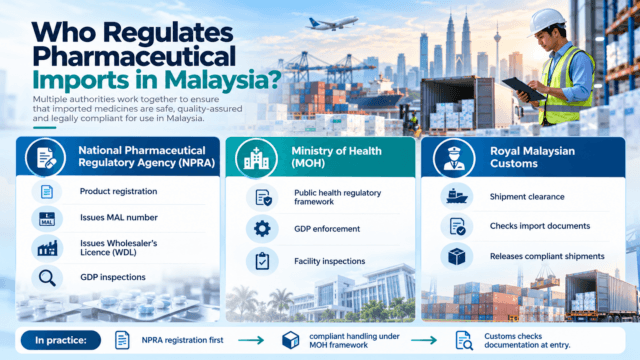
Pharmaceutical importation in Malaysia sits under a regulatory structure with two primary authorities, each with a distinct role in the process.
The National Pharmaceutical Regulatory Agency (NPRA)
NPRA, operating under the Ministry of Health, is the primary regulator for pharmaceutical products in Malaysia. NPRA administers product registration, the process by which a pharmaceutical product receives a MAL number confirming it has been assessed for safety, efficacy, and quality and issues the Wholesale Dealer’s Licence that authorises a company to import and distribute pharmaceutical products. NPRA also conducts GDP inspections of licensed importers and distributors, and holds enforcement authority including licence suspension and product seizure for non-compliance.
NPRA’s public register at npra.gov.my allows anyone to verify a company’s WDL status and confirm whether a specific product holds a valid MAL number. This should be the first verification step before engaging any importer or distributor, and before accepting any product for import that has not been confirmed as registered.
The Ministry of Health (MOH) and Royal Malaysian Customs
The Ministry of Health sets the overarching public health regulatory framework within which NPRA operates, and holds authority over GDP enforcement and facility inspections for licensed pharmaceutical operators. Royal Malaysian Customs Department is the agency responsible for physically clearing pharmaceutical shipments at the point of entry such as Port Klang, Kuala Lumpur International Airport, and other designated points and will not release a pharmaceutical shipment without the correct NPRA documentation presented alongside standard customs paperwork.
These three bodies operate in sequence during an import event: NPRA registration must exist before the shipment departs the country of origin, MOH’s GDP framework governs how the product must be handled once it clears customs, and Customs is the physical checkpoint that verifies the registration documentation is in order before releasing the shipment.
Pharmaceutical Product Registration Before Importation
Product registration is not a parallel process to importation, it is a strict prerequisite. Under Malaysian pharmaceutical regulation, no product can be legally imported for commercial sale without a valid MAL number issued by NPRA. This single requirement is the source of more market entry delays and cost overruns than any other step in the Malaysian pharmaceutical supply chain.
The MAL number and what NPRA registration confirms
The Malaysian Approval Letter (MAL) is the registration confirmation issued by NPRA once a pharmaceutical product has passed its safety, efficacy, and quality assessment. Every pharmaceutical product sold in Malaysia such as prescription medicines, OTC products, and biologics alike must carry a valid MAL number before it can be legally imported for commercial distribution. The MAL number is product-specific and, for most product categories, needs to be renewed periodically in line with NPRA’s registration validity period.
Registration assesses the product’s manufacturing quality documentation, clinical and safety data, labelling compliance, and in many cases requires evidence of registration or approval in the country of origin or another reference regulatory authority. The depth of the assessment scales with the product’s risk profile, a Category C OTC product is reviewed less intensively than a novel biologic.
Registration timeline and what it means for import planning
Realistic NPRA registration timelines vary by product type and complexity, but foreign manufacturers should plan for a process that typically runs from several months to over a year for more complex products, and should never assume registration can be completed in parallel with a shipment already in transit. A product with incomplete registration cannot legally be imported for sale, regardless of how far along the application has progressed.
The practical implication for market entry planning is straightforward: registration should begin well before any commercial shipment is planned, and confirmed MAL status should be treated as a hard gate before committing to an import date. For foreign brands working with a Malaysian pharmaceutical distributor who can coordinate the registration process, this timeline risk is considerably easier to manage than attempting to navigate NPRA directly from overseas.
Who submits the registration application
Product registration applications to NPRA are typically submitted by the Malaysian-based licence holder, usually the importer or distributor acting on behalf of the foreign manufacturer, or a registered local agent appointed specifically for the purpose. A foreign manufacturer without a Malaysian entity or appointed local representative cannot submit directly to NPRA. This is one of the clearest reasons that a capable local partner, engaged early, materially shortens the path to market.
What Licence Does a Pharmaceutical Importer Need in Malaysia?
Holding the correct licences is the foundation of legal pharmaceutical importation in Malaysia. The requirements are consistent regardless of company size or product category, what varies is the additional certification needed for specific product types such as medical devices or cold chain products.
Wholesaler’s Licence (WDL) with import authorisation
The Wholesaler’s Licence, issued by NPRA, is the core licence required to import and distribute pharmaceutical products in Malaysia. Not every WDL automatically includes import authorisation, this is a specific condition that must be confirmed as part of the licence scope. A company holding a WDL for distribution only, without import authorisation, cannot legally act as the importer of record for a shipment.
Verifying a prospective import partner’s WDL status and confirming that it explicitly covers import activity is a non-negotiable first step. This can be confirmed directly through NPRA’s public register, and any partner unwilling to produce this confirmation should be treated as a significant risk flag.
GDP compliance for import handling and storage
Good Distribution Practice requirements apply to a pharmaceutical importer from the moment a shipment clears customs. This means the importer must have GDP-compliant warehousing ready to receive the product including appropriate temperature-controlled storage for the product category, batch traceability systems, and documented receiving procedures. For products requiring a cold chain, this extends to qualified cold storage and temperature-controlled transport from the point of customs clearance onward. See our guide to pharmaceutical warehouse requirements Malaysia for the full storage compliance breakdown.
Additional licensing for medical devices and controlled substances
Importers bringing in medical devices alongside pharmaceutical products require separate Establishment Licence and GDPMD certification from the Medical Device Authority (MDA), a distinct regulatory framework from NPRA’s pharmaceutical licensing. Products classified as controlled substances or scheduled poisons carry additional import permit requirements and stricter storage and security conditions. Foreign manufacturers with a mixed portfolio of pharmaceuticals and medical devices should confirm their Malaysian partner holds both licensing tracks rather than assuming one licence covers both categories. See our guide to medical device distributor Malaysia for the MDA licensing framework.
Step-by-Step: How to Start Importing Pharmaceuticals into Malaysia
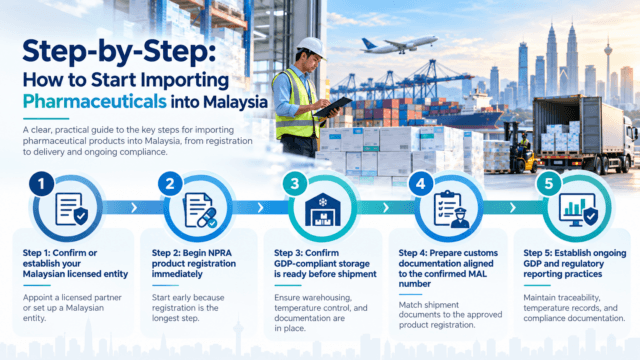
For a foreign pharmaceutical brand planning to enter the Malaysian market, or a company establishing a new import operation, the sequence below reflects the order in which these steps genuinely need to happen.
Step 1: Confirm or establish your Malaysian licensed entity.
Either appoint an existing WDL holder with import authorisation as your partner, or establish a Malaysian entity and apply for the WDL directly. For most foreign manufacturers, partnering with an established, licensed distributor is significantly faster than building licensing capability from zero.
Step 2: Begin NPRA product registration immediately.
Do not wait for a distribution agreement to be finalised before starting this process. Registration is the longest single step in the sequence, and it should run in parallel with commercial and operational planning, not after it.
Step 3: Confirm GDP-compliant storage is ready before shipment.
Your importer’s warehouse must have the appropriate storage zones, temperature control, and documentation systems in place before the first shipment arrives. An unprepared facility at the point of customs clearance creates delays that are entirely avoidable.
Step 4: Prepare customs documentation aligned to the confirmed MAL number.
Once registration is confirmed, the commercial invoice, packing list, and MAL confirmation must be assembled correctly for the shipment. Errors or mismatches at this stage are a common source of customs delay.
Step 5: Establish ongoing GDP and regulatory reporting practices.
Importation is not a one-time event. Batch traceability, temperature records, and any post-registration regulatory obligations must be maintained as an ongoing operational discipline from the first shipment onward.
Pharmaceutical importation in Malaysia rewards preparation and penalises shortcuts. The single most expensive mistake a foreign manufacturer can make is treating registration and importation as parallel tracks that will meet in the middle. They do not. Registration must be confirmed before a single commercial unit crosses the border, and the company handling that import must hold licensing that explicitly covers the activity. Get the sequence right, and market entry is a matter of realistic timeline planning. Get it wrong, and the cost is measured in storage fees, delayed launches, and stock that cannot legally reach the patients it was made for.
Frequently Asked Questions
For normal commercial supply, pharmaceutical products generally need to be registered with the Drug Control Authority, and the person carrying out the import activity must hold the appropriate licence, subject to applicable exemptions.
The Product Registration Holder must be a locally incorporated company or legal entity registered in Malaysia. An overseas product owner can appoint a Malaysian company as its authorised PRH.
A shipment without a valid MAL number will not be released by Royal Malaysian Customs for commercial distribution. The product may be held in a bonded facility pending registration, returned to the country of origin, or in serious cases, subject to seizure. This also exposes the importer to regulatory action from NPRA, including potential licence consequences.
Check NPRA’s public register at npra.gov.my to confirm the company holds a current Wholesale Dealer’s Licence, and specifically verify that the licence conditions include import authorisation, not distribution alone. You can also request the licence document directly and cross-check its details against the public register.
Not necessarily, but in practice they very often are. Many Malaysian WDL holders are licensed for both import and distribution activity, making it operationally simpler for foreign brands to work with a single partner across both functions rather than coordinating separate importer and distributor relationships.
Looking for a licensed pharmaceutical importer in Malaysia?
Octopus Distribution holds a Wholesaler’s Licence covering import and distribution, GDP-compliant warehousing, and NPRA registration coordination support for foreign pharmaceutical brands entering the Malaysian market.
Contact our team to discuss your import and distribution requirements.





