
For pharmaceutical and medical device companies, the cold chain has always been unforgiving. A temperature excursion of just a few degrees can render a batch of biologics ineffective, compromise a shipment of temperature-sensitive surgical devices, or trigger a costly regulatory investigation. The margin for error is essentially zero.
But the variables that cold chain professionals have spent decades planning around include average ambient temperatures, seasonal weather patterns, and the reliability of power infrastructure are shifting.
For companies operating in Malaysia and across Southeast Asia, the effects of climate change on pharmaceutical logistics is already here, already measurable, and already showing up in operational data. The question is whether your distribution partner is prepared for the version of the cold chain that exists in 2030 and beyond.
The Cold Chain Was Not Designed for This Climate
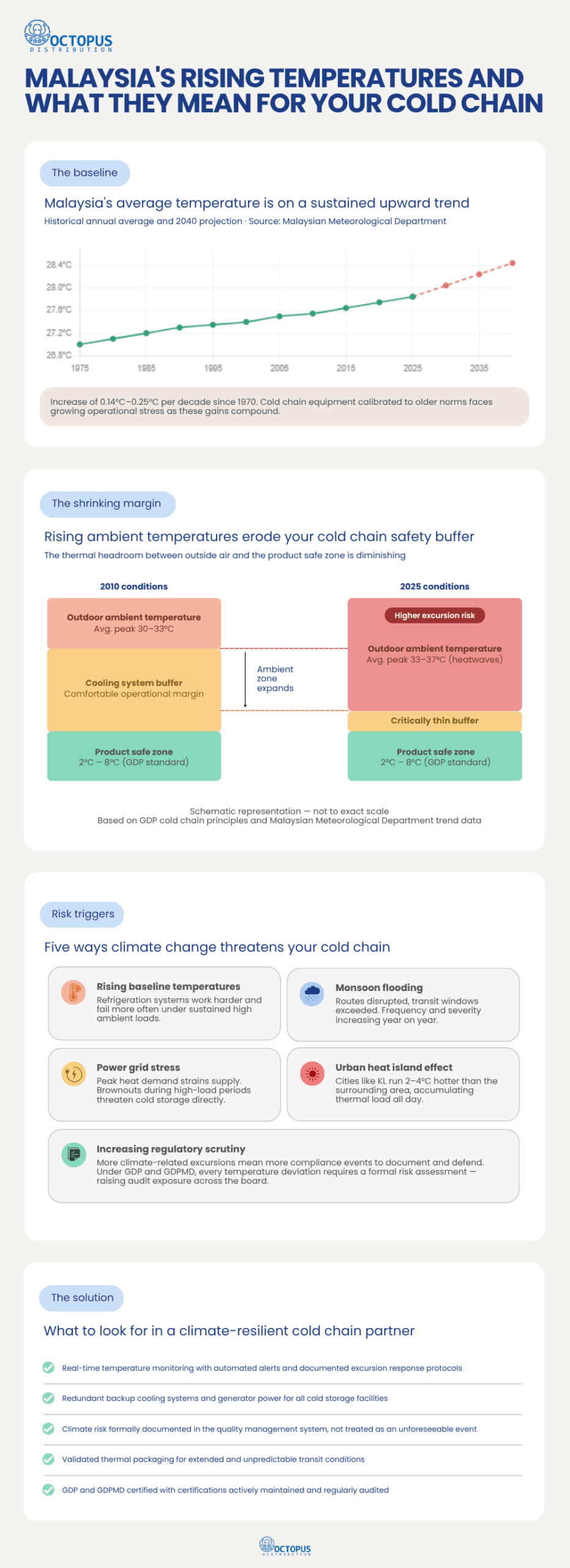
Malaysia’s average temperature has increased by approximately 0.14°C to 0.25°C per decade since the 1970s, according to a climate risk profile by the World Bank Group. While that number sounds modest in isolation, in the context of cold chain logistics, it is not.
Cold chain infrastructure such as refrigerated trucks, warehouse cooling systems, temperature monitoring equipment, is typically engineered and calibrated against historical ambient temperature ranges. When those ranges shift upward consistently, equipment that was once operating comfortably within its performance envelope starts working harder, consuming more energy, and failing more frequently.
A refrigerated vehicle running a delivery route through Klang Valley during a 35°C afternoon is under meaningfully more thermal stress than the same vehicle on the same route at 30°C. The compressor cycles more. The door seals degrade faster. And when there is a delay like a traffic jam, a missed delivery window, an administrative hold at a hospital receiving bay, the thermal buffer that keeps your product within spec is thinner than the logistics plan assumed.
Climate Change Risk Disrupting Distribution Networks
Beyond the baseline temperature increase, Malaysia is experiencing more frequent and more intense extreme weather events. Prolonged heatwaves, heavier monsoon flooding, and increasingly unpredictable weather patterns that compress and extend seasonal norms.
For cold chain logistics, each of these creates a distinct category of risk.
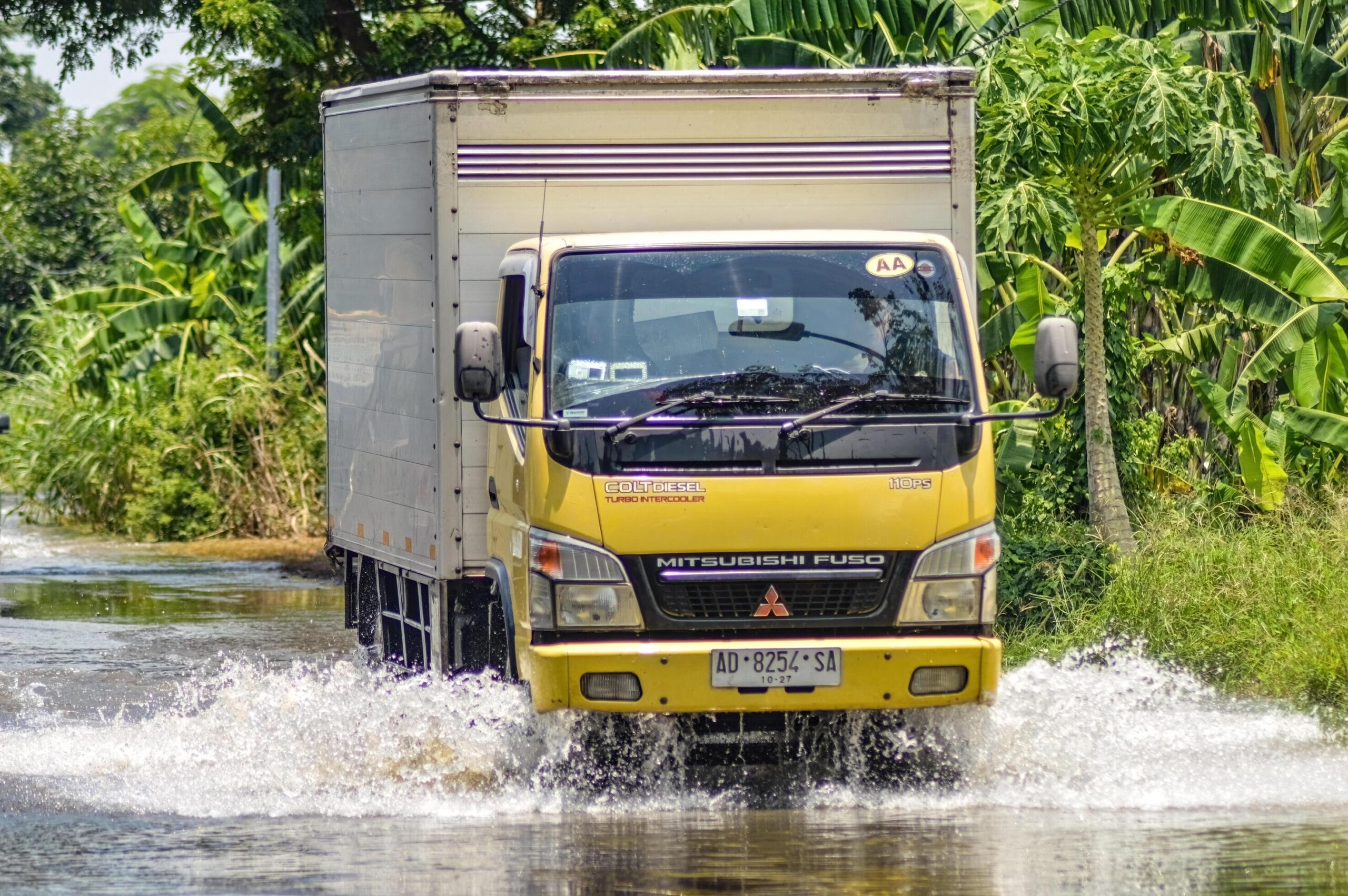
Flooding is the most operationally visible. When major roads in the Klang Valley, Johor, or Kelantan become impassable, pharmaceutical delivery schedules collapse. For ambient products, a delay is a commercial inconvenience. For cold chain products including vaccines, insulin, biologics, a delivery delay that exceeds the product’s validated transport window is a product loss event.
In 2021 and 2022, Malaysia experienced some of the worst flooding in decades, and supply chain disruptions in healthcare were widely reported. These events are becoming more frequent, not less.
Power grid instability is a less discussed but equally serious risk. Extended heat periods increase electricity demand across the board, and grid stress events (brownouts and outages) disproportionately affect cold storage facilities that are running at high load to compensate for elevated ambient temperatures. A cold chain warehouse cold room that loses power for four hours during a peak summer afternoon faces a very different thermal recovery challenge than one that loses power on a mild evening.
Extended heatwaves are particularly dangerous for the last mile. When temperatures stay elevated overnight, which is increasingly common in urban heat islands like Greater Kuala Lumpur, refrigerated vehicles that rely on passive cooling during loading and unloading get less overnight recovery time. The cumulative thermal load across a full delivery day grows.
Infrastructure Built for Yesterday’s Climate
A significant portion of cold chain infrastructure in Southeast Asia including warehouses, vehicles, and monitoring systems, was designed and built during a period of lower average temperatures and more predictable weather patterns. Much of it has not been systematically upgraded to account for what the climate now is, let alone what it will be.
Cold chain warehouses built to maintain 2–8°C when the outside temperature peaks at 32°C face a materially different engineering challenge when the outside temperature regularly peaks at 36°C or higher. The cooling system must work harder, energy costs rise, and the risk of a system failure increases.
Refrigerated vehicles face a similar problem. Fleet replacement cycles in logistics are typically long. A vehicle purchased in 2015 with a refrigeration unit designed for the climate conditions of that period may be operating outside its optimal performance envelope today, particularly during peak summer conditions or on long urban delivery routes with frequent door openings.
This infrastructure gap is one of the more concrete and measurable ways that climate change translates into real cold chain risk. It is also one of the clearest areas where choosing a distribution partner with modern, well-maintained facilities and a proactive investment posture matters enormously.
Cold Chain Temperature Monitoring in a Changing Climate
Cold chain temperature monitoring has always been a regulatory requirement. Under GDP and GDPMD guidelines, continuous temperature recording during storage and transit is the documented proof that a product’s integrity was maintained from facility to end point. But as Malaysia’s climate becomes less predictable, monitoring is evolving from a compliance checkbox into an active risk management tool.
A monitoring system that simply records data after the fact tells you that an excursion happened. A monitoring system that detects deviations in real time, triggers automated alerts, and initiates a defined response protocol gives your team the window to intervene by rerouting a delivery, activating backup cooling, or quarantining a shipment, before a regulatory event becomes a product loss event.
What modern cold chain monitoring should cover:
- Temperature sensors across cold rooms, vehicles, and packaging units should feed into a centralised dashboard with continuous data logging. For pharmaceutical products requiring storage at 2–8°C, a deviation of even a few degrees can begin compromising product integrity within hours.
- Automated alerting with defined escalation paths is what separates a monitoring system from a monitoring tool. An alert that reaches a warehouse supervisor’s phone at 2am during a power outage with a clear protocol for what to do next is better than one that just generates a log entry.
- Temperature excursions are most likely to occur at transition points: during loading and unloading, in transit through urban heat corridors, and at last-mile delivery destinations where receiving conditions are outside the distributor’s control. A robust monitoring approach accounts for the full cold chain journey, not just the controlled facility environment.
At Octopus, our temperature monitoring infrastructure is built into a customised warehouse management system designed specifically for healthcare products.
What a Climate-Resilient Cold Chain Partner Looks Like

Continuous monitoring with alert thresholds
Real-time temperature monitoring across storage and transit is now a baseline expectation. What differentiates a resilient partner is how quickly deviations are detected, how escalation protocols are triggered, and how comprehensively events are documented for regulatory purposes. Automated alerting with defined response procedures is the appropriate standard.
Redundant cooling systems
For warehouse cold storage, backup cooling capacity and generator systems should not be optional. A single point of failure in a cooling system during a heatwave is an unacceptable risk for temperature-sensitive pharmaceutical products.
Climate-aware route planning
Delivery routes and scheduling should account for ambient temperature risk by avoiding peak heat windows for sensitive products where possible, flagging high-risk delivery points (e.g., clinics without controlled receiving environments), and building in contingency time for weather-related delays.
Validated packaging for extended excursion risk
As delivery timelines become less predictable due to extreme weather events, the validated transport time of your thermal packaging becomes more important. A distribution partner that works with qualified packaging suppliers and maintains transport validation data gives you documented evidence that your product was protected.
Documented climate risk in the QMS
A distribution partner operating under ISO 9001 and GDPMD should have climate-related risks formally identified within their quality management system. If a partner cannot show you how climate variability is addressed in their risk register, that is a gap worth probing.
The Business Case for Acting Now
There is a tendency in supply chain planning to treat low-frequency, high-impact events as acceptable background risk like it’s something to manage reactively when it happens, rather than proactively through investment and partner selection.
Climate change is dismantling that logic. What was genuinely low-frequency a decade ago is becoming medium-frequency. What was medium-frequency is becoming routine. The cost of a single cold chain failure, whether it’s product loss, regulatory investigation, patient safety incident, brand damage with a hospital or clinic customer, almost always exceeds the cost of the preventive measures that would have avoided it.
The companies that will manage this well are the ones that treat cold chain partner selection as a strategic decision and that are asking their distribution partners hard questions about infrastructure investment, monitoring capability, and climate risk planning today, before the next extreme weather event makes those questions urgent.
Rising ambient temperatures, more frequent extreme weather, ageing infrastructure, and higher regulatory expectations are converging into a risk profile that demands a more rigorous approach to cold chain logistics than most companies currently apply.
The good news is that the gap between adequate and genuinely resilient cold chain operations is closeable. It requires investment in the right infrastructure, the right monitoring systems, and the right partner relationships.
Octopus Distribution operates GDP and GDPMD-certified cold chain logistics from our facility in Puchong, Selangor, serving pharmaceutical and medical device companies across Malaysia. If you’d like to discuss how we manage temperature-sensitive products and climate-related cold chain risk, contact our team.





